What Speed on Walking Pad to Lose Weight

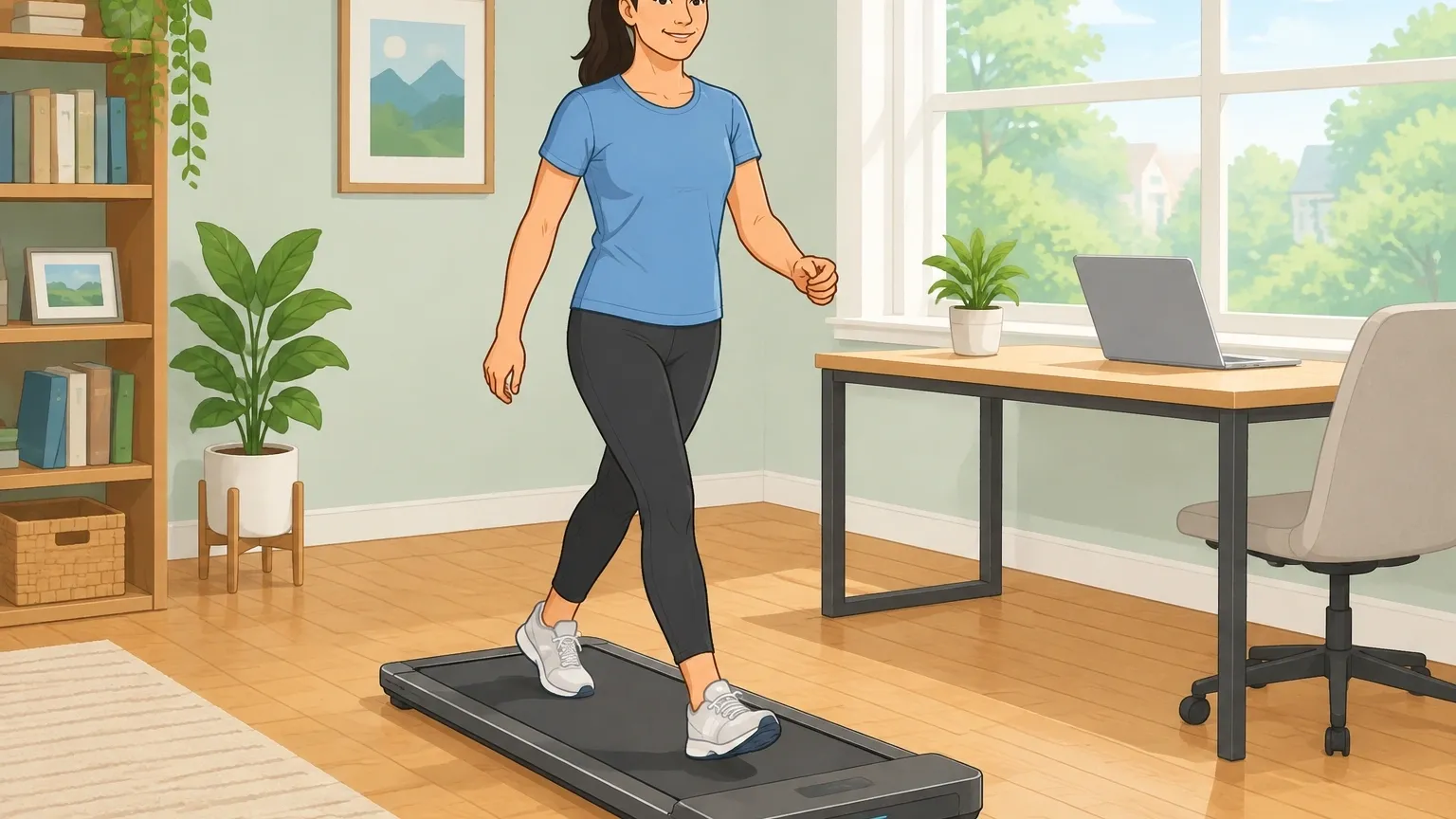
If you want to lose weight with a walking pad, the most effective speed is between 3 and 4 miles per hour (mph). That is about 4.8 to 6.4 kilometers per hour.
This range counts as brisk walking. It gets your heart rate up enough to burn fat but is slow enough that you can keep walking for 30 to 60 minutes without getting worn out.
Walking slower than 2 mph is too easy. Your body barely works harder than it does sitting still.
Walking faster than 4.5 mph often forces you to hold onto a desk or lean forward, which ruins your form and lowers the calories you actually burn.
The sweet spot for weight loss is that 3 to 4 mph range.
The Optimal Speed Range for Weight Loss on a Walking Pad
Most people find that 3.5 mph is the perfect starting point. At this speed, you cover one mile in about 17 minutes.
A 155-pound person burns roughly 150 calories in 30 minutes at this pace on a flat surface.
Here is how the speed affects your calorie burn:
| Speed (mph) | Calories Burned per 30 Minutes* | Feeling |
|---|---|---|
| 2.0 | 90 | Easy, casual stroll |
| 3.0 | 130 | Moderate, slight sweat |
| 3.5 | 150 | Brisk, steady breathing |
| 4.0 | 180 | Fast, hard to hold conversation |
| 4.5+ | 200+ | Very hard, often leads to poor form |
*Based on a person weighing 155 pounds. Heavier people burn more, lighter people burn less.
Do not jump straight to 4 mph if you are new to walking pads. Start at 2.5 mph for a few days. Increase by 0.2 mph each session until you reach 3.5 mph.
That gradual ramp-up helps your muscles and joints adapt without injury.
How to Find Your Personal Fat-Burning Speed
The number on the screen is just a guide. Your actual fat-burning speed depends on your fitness level, age, and body weight. Use the talk test to find your ideal pace:
- Start walking at 3 mph.
- After 5 minutes, try to speak a full sentence out loud.
- If you can talk easily without gasping, speed up by 0.2 mph.
- If you cannot finish a sentence without taking a breath, slow down by 0.2 mph.
- The right speed is where you can say a few words but not sing a song.
A more precise method uses your heart rate. Your fat-burning zone is 60 to 70 percent of your maximum heart rate. Calculate it as:
- Maximum heart rate = 220 minus your age.
- Target zone = that number multiplied by 0.6 and 0.7.
For example, a 40-year-old has a max heart rate of 180. Their fat-burning zone is 108 to 126 beats per minute.
Wear a chest strap or a fitness watch to check if your walking speed keeps your heart rate in that range.
Why Speed Alone Isn't Enough: The Role of Incline and Duration
Walking at 3.5 mph on a flat pad is good, but adding incline makes it much better. A 2 to 5 percent incline can boost your calorie burn by 40 to 60 percent without forcing you to walk faster.
- 3 mph at 0% incline: ~150 calories per 30 minutes.
- 3 mph at 5% incline: ~225 calories per 30 minutes.
Incline also engages your glutes and hamstrings more than flat walking does. That builds muscle, and more muscle means you burn more calories even when you are sitting at your desk later.
Duration matters just as much as speed. A 20-minute walk at 4 mph burns fewer total calories than a 45-minute walk at 3 mph. For weight loss, aim for 30 to 60 minutes per session.
Advanced Strategies: Intervals, Steady-State, and Progressive Overload
Your body adapts to the same routine in about three weeks. To keep losing weight, change how you structure your walking sessions.
Fat-Burning Steady-State Walk
This is your daily routine. Walk at 3.2 to 3.5 mph with 0 to 2 percent incline for 30 to 45 minutes. Keep your heart rate in the fat-burning zone. Do this 5 to 6 days per week.
Incline Interval Walk
This raises your heart rate higher and burns more calories in less time. Do it 2 to 3 times per week.
- Warm-up: 3 minutes at 2.5 mph, 0% incline.
- Work interval: 3 minutes at 3.5 mph, 4% incline.
- Recovery: 2 minutes at 2.5 mph, 0% incline.
- Repeat work and recovery 5 to 6 times.
- Cool down: 3 minutes at 2.0 mph, 0% incline.
Progressive Overload Walk
Each week, increase one variable by a small amount. This prevents plateaus.
- Week 1: Speed 3.0 mph, 30 minutes, 0% incline.
- Week 2: Speed 3.2 mph, 32 minutes, 0% incline.
- Week 3: Speed 3.2 mph, 35 minutes, 1% incline.
- Week 4: Speed 3.5 mph, 35 minutes, 1% incline.
Common Mistakes That Sabotage Walking Pad Weight Loss
Most people fail because they focus on speed alone and ignore other factors. Here are the mistakes I see most often:
- Walking too slow (under 2 mph): This burns almost no extra calories. You might as well be sitting.
- Holding onto a desk or handrail: This reduces your calorie burn by up to 20 percent because your arms and core do less work. Keep your arms free and swinging.
- Using only a flat surface: Your body gets used to the same motion. Add incline to keep challenging your muscles.
- Not tracking duration: Speed means nothing if you only walk for 10 minutes. Set a timer for at least 30 minutes.
- Poor posture: Looking down at a phone or slouching makes your lower back work harder and your legs work less. Stand tall, keep your shoulders back, and look forward.
Frequently Asked Questions
Can I lose weight walking at 2 mph on a walking pad?
Yes, but it is very slow. You need 60 or more minutes per day to create a meaningful calorie deficit. A faster speed or a slight incline will make your time more productive.
Is it better to walk faster for a shorter time or slower for longer for weight loss?
Slower for longer is usually better for weight loss. A 45-minute walk at 3 mph burns more total calories than a 20-minute walk at 4 mph. Longer walks are also easier to do every day without injury.
Should I use a heart rate monitor on my walking pad?
Yes. The fat-burning zone is 60 to 70 percent of your maximum heart rate. Many walking pads do not have heart rate grips, so a simple chest strap or a fitness watch is worth using.
How does walking pad speed compare to outdoor walking for weight loss?
Outdoor walking often burns slightly more calories because of wind resistance and uneven ground.
But a walking pad lets you control speed and incline precisely, which makes it easier to structure a consistent fat-burning workout.