Is an under desk treadmill good for sciatica and lower back pain?


If you spend hours at a desk and deal with shooting leg pain or a tight lower back, you have probably wondered whether a walking pad is a smart addition or just an expensive mistake.
The honest answer is: it depends on where you are in your recovery – and how you use it.
Under the right conditions, an under desk treadmill can ease nerve pain by getting you moving in a low-impact way. Under the wrong conditions, it can trigger a flare-up that sets you back weeks.
Here is what I learned from using one, what the research says, and the exact settings that make the difference.
The Short Verdict on Walking Pads and Nerve Pain
Yes, an under desk treadmill can help with sciatica and lower back pain – but only in the chronic phase, at a slow, flat pace, and with strict attention to your body's signals.
For roughly 1 in 5 people with specific structural issues, it may actually make things worse.
The best way to think about it is the Two-Phase Rule:
- Acute flare-up phase: The nerve root is inflamed and aggravated. Any repetitive movement, even gentle walking, can irritate it further. In this phase, avoid the treadmill and lean toward rest, gentle mobility work, and your doctor's guidance.
- Chronic management phase: The intense pain has settled. Your body is ready for controlled movement. Here, a walking pad can be one of the most effective tools to keep the nerve gliding, strengthen the back, and prevent stiffness.
These two phases require completely different responses. Treating a chronic-phase tool as an acute-phase cure is where most walking-pad injuries happen.
Why Walking Relieves Some Back and Leg Pain
Walking is not just "better than nothing." It actively addresses several mechanisms that drive sciatic pain. Understanding why it works will help you trust the process when it feels too easy.
Nerve Gliding at Work
The sciatic nerve needs to slide freely through the tunnels of muscle and tissue as you move.
When you sit for long periods, the nerve stays tether in one position, and the surrounding tissue can become stiff and inflamed.
Slow, rhythmical walking creates a gentle, continuous glide of the nerve. That motion helps it move without friction, reducing the "pulling" sensation many people feel down the back of the leg.
Spinal Disc Hydration
The discs between your vertebrae act like water-filled cushions. They do not have their own blood supply.
Instead, they absorb nutrients and flush waste through a pumping action that happens when the spine moves through its full range.
Sitting all day keeps the spine in a fixed, bent position, which raises pressure inside the disc.
Walking shifts that pressure rhythmically, which encourages fluid exchange and keeps the discs nourished and pliable.
Endorphins and the Pain Gate
Low-intensity aerobic activity like walking releases endorphins, which are natural pain-modulating chemicals.
It also activates the "pain gate" mechanism in the spinal cord, where signals from gentle movement can actually override and reduce the intensity of pain signals.
That is why a slow stroll can make your back feel less angry even before any structural change has occurred.
Notice the difference between walking and running here. Running produces a high-impact heel strike with each stride that sends shockwaves up the spine and can compress nerve roots.
A slow walking stride is smooth and low-impact. That is why a treadmill at 1.5 miles per hour can be therapeutic while a treadmill at 5 miles per hour is anything but.
When an Under Desk Treadmill Worsens Sciatica
Now for the side nobody talks enough about. The same device that helps one person can flare up another person's pain, and the deciding factor is often the specific cause of their sciatica.
The Acute Disc Herniation Problem
During the first couple of weeks after a disc herniation, the nerve root is swollen and sensitive.
Walking on a treadmill keeps your lumbar spine in a slightly extended position, especially if you let your posture sag.
That extension, combined with the vibration of the motor, can push the protruding disc further into the nerve. In this phase, even a gentle incline can be a disaster.
I learned this the hard way when I left the incline set at a few percent after an early flare-up – it took two days to get the pain back under control.
The Spinal Stenosis Puzzle
This is the counter-intuitive one. For lumbar spinal stenosis – a condition where the spinal canal narrows – walking uphill is often more comfortable than walking on flat ground.
Bending forward slightly (flexion) opens up the canal, so an incline can actually help. But a flat treadmill at a slow speed often causes the legs to ache and go heavy within minutes.
If you have been told you have stenosis, you may want to test a small incline under guidance rather than assume flat is safest.
The Instability Risk
If you have spondylolisthesis, where one vertebra slips forward over another, the repetitive motion of walking can increase the shearing forces on that unstable segment.
That is not the type of movement that helps. It tends to aggravate the nerve root further and can make the leg pain worse.
Stop immediately if walking brings on increased numbness, tingling, weakness, or pain that shoots down your leg. Muscle soreness after exercise is normal.
Nerve pain during exercise is not. That is not "good pain" – it is a sign that the wrong nerve is being irritated, and pushing through it can cause lasting damage.
The Right Way to Use a Treadmill for Back Pain
If you are in the chronic phase and your doctor has given you the all-clear, how you use the treadmill matters more than the brand you choose.
Here are the parameters that separate a helpful session from a harmful one.
Speed and Incline
Start at 1.0 to 1.5 miles per hour. This is a slow stroll, not a power walk. At this pace, your stride stays short and your spine stays relatively steady.
Resist the urge to increase the speed because you feel good. That feeling is exactly what tempts people into overdoing it and triggering a flare-up.
Keep the incline at 0% flat for general sciatica.
As mentioned, a slight incline can sometimes support people with stenosis, but for a common herniated disc or non-specific lower back pain, flat is the only safe starting point.
Small changes in incline dramatically change the load on your lumbar spine.
Duration and Frequency
Short sessions beat long ones. I recommend 10 to 15 minutes at a time, with a slower ramp-up at the beginning and end.
Do not try to walk for an hour to "catch up" on all the sitting you did earlier in the day. That is a recipe for delayed pain.
Two or three short sessions spread across the day are more effective and far easier on the nerve than one long stretch.
Posture and Form
Keep your gaze forward and your shoulders relaxed. Do not look down at your phone, because that flexes your neck and upper back, which pulls on the entire kinetic chain.
Your core should be lightly engaged, and your lower back should feel neutral – not arched, not hunched.
Footwear and Desk Setup
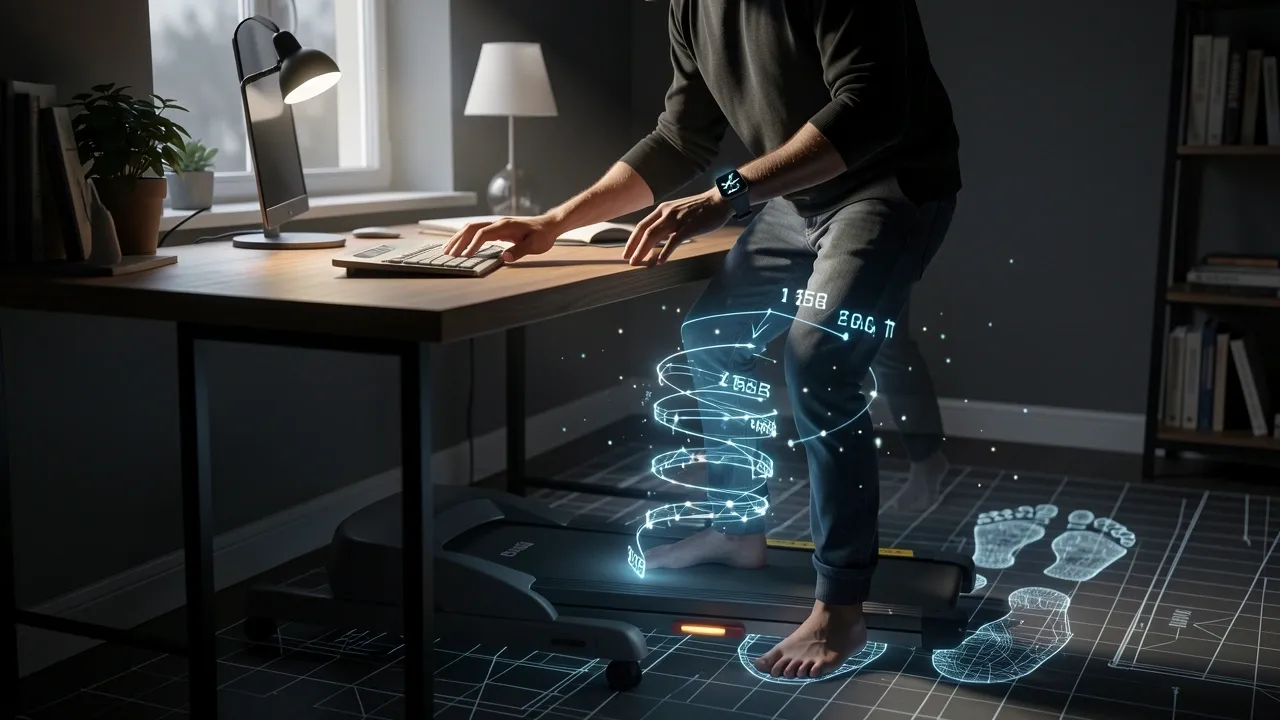
Wear supportive athletic shoes, even if you are at home. Walking barefoot or in dress shoes on a treadmill belt changes your foot strike and can throw your alignment off.
And make sure the treadmill height lines up with your desk so you are not reaching up or slumping down to type. Your elbows should rest near a 90-degree angle while you walk.
| Setting | General Sciatica | Why It Matters |
|---|---|---|
| Speed | 1.0–1.5 mph | Keeps your stride short and your spine steady |
| Incline | 0% flat | Avoids excess extension and compression |
| Duration | 10–15 minutes | Prevents overloading from long, repetitive motion |
| Posture | Neutral spine, eyes forward | Reduces strain on the lumbar curve |
| Footwear | Supportive shoes | Maintains proper foot strike and alignment |
Who Should Skip the Under Desk Treadmill Entirely
Some signs mean you should not use a walking pad at all – not even at a slow speed. These are absolute red flags, not suggestions.
- Cauda equina syndrome: Numbness in the saddle area (where you sit), loss of bowel or bladder control, or sudden weakness in both legs. This is a medical emergency requiring immediate attention.
- Progressive foot drop: If you cannot lift the front of your foot while walking, or if that weakness is getting worse, stop and see a doctor. This is a sign of significant nerve damage.
- Severe osteoporosis or a recent spinal fracture: The vibration and repetitive load of walking on a powered belt can stress fragile bones.
Even if you do not have those conditions, if a short session on a walking pad repeatedly increases your numbness, tingling, or weakness, that device is not for you.
Your body is telling you that the nerve is not tolerating the movement, and no amount of slow pace will change that.
Better Alternatives to Consider
If the treadmill does not work for your situation, do not give up on movement at your desk. There are other tools that may fit your specific condition better.
| Option | Impact | Best For | Watch Outs |
|---|---|---|---|
| Under desk elliptical | Very low | People who want leg movement without standing | Can tighten hip flexors if used too long |
| Recumbent bike | Low | Disc issues and acute phases, because the spine stays supported | Need to support the lumbar curve with a towel roll |
| Standing desk | None | People who just want to break up sitting time | Prolonged standing can still stress the lower back |
In my experience, the under desk elliptical is a decent fallback because you can use it from a seated position, but it does not give you the same gliding motion for the sciatic nerve that walking does.
A recumbent bike is the safest choice for anyone with a recent disc injury, as the backrest keeps your spine in a supported, relaxed position.
A standing desk is not a replacement for walking; it only changes the posture you are stuck in.
Frequently Asked Questions
Can walking on a treadmill make a herniated disc worse?
Yes, during the acute phase of a herniation, walking on a treadmill can make it worse by keeping the nerve root irritated and by adding repeated pressure to the inflamed disc.
In the chronic phase, after the inflammation has settled, a slow, flat-paced walk on a treadmill is usually safe and beneficial.
Is it okay to use a walking pad every day for back pain?
Daily use is fine if you keep each session short – 10 to 15 minutes – and maintain a slow, flat pace. Taking a rest day when you feel any increased tenderness is smart.
Overuse is a common trigger for flare-ups, so treat daily as a goal, not a rule.
Should I use an incline or flat setting for lower back pain?
For general sciatica and most mechanical lower back pain, use the flat setting at 0% incline.
A slight incline can help some people with lumbar spinal stenosis by opening the spinal canal, but it can worsen pain for those with disc problems.
If you are unsure, consult a physical therapist before experimenting with incline.
Is a treadmill desk better than a standing desk for sciatica?
For sciatica, a treadmill desk is generally better because continuous gentle movement supports nerve gliding and disc hydration, whereas standing still can actually increase pressure on the lumbar spine over time.
The exception is during an acute flare-up, when any movement may be too much and a standing or supported sitting position is better.
How long does it take to notice pain relief from walking?
Some people feel relief during or immediately after a short walk because of the endorphin effect.
Structural improvements from increased disc hydration and nerve mobility usually take a few weeks of consistent daily walking.
If you do not notice any improvement after two weeks, reassess your approach or get a professional opinion.