Is a Walking Pad the Same as Walking Outside?

No. They are not the same, and here is why that matters.
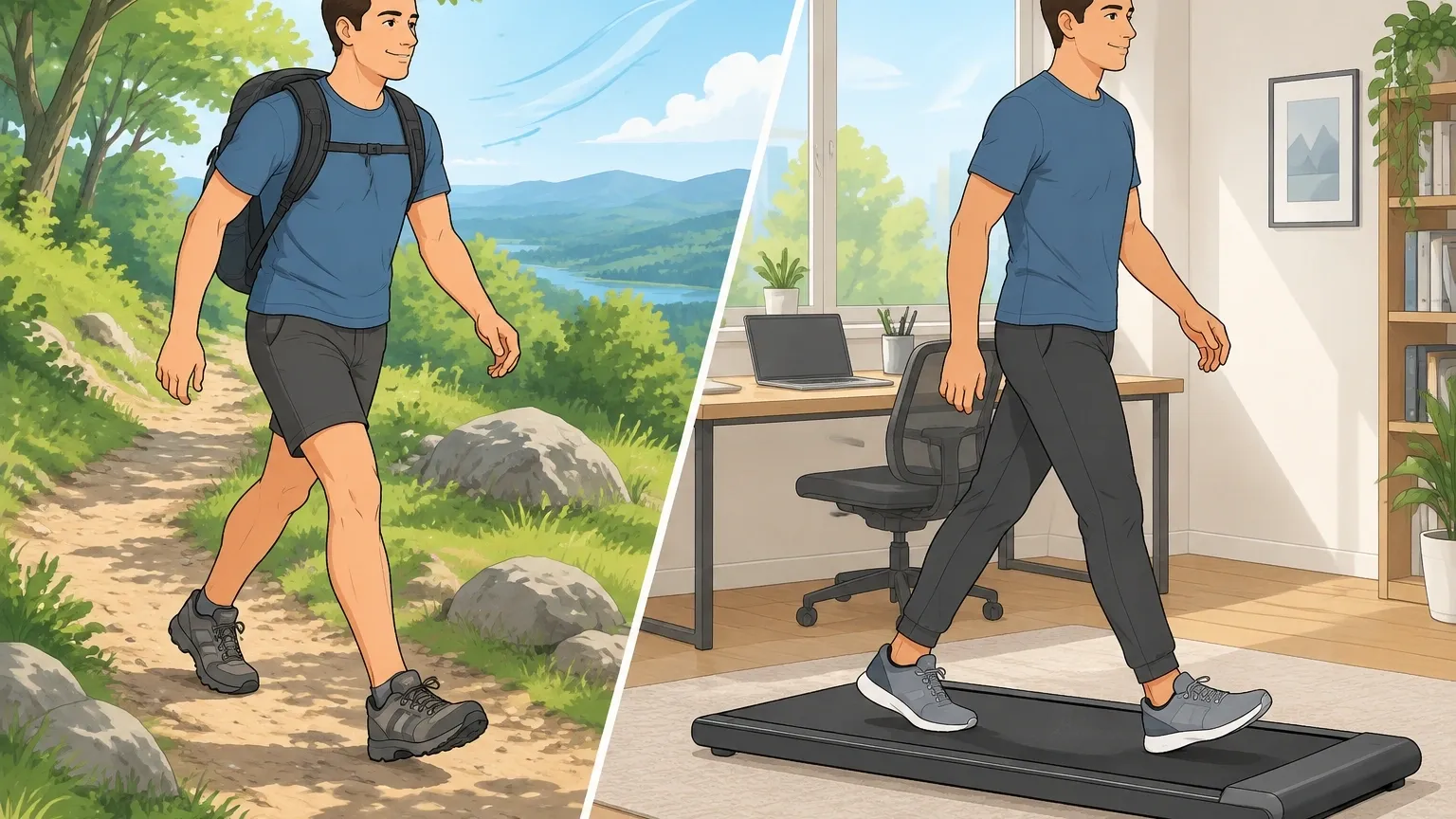
If you want a simple yes or no, this is it: a walking pad gives you steps, while walking outside gives your body a full workout that includes balance, strength, and nervous system benefits.
One is a tool for convenience. The other is a form of functional movement that your body evolved to do. Understanding the difference will help you decide which one fits your actual goal.
Why Walking Outside Is a Harder Workout Than a Walking Pad
Walking outside demands more from your body because the environment is inconsistent. On a walking pad, the motor moves the belt. Your leg just has to keep up with that movement.
Outside, you have to initiate every step by pulling your body forward. That changes which muscles do the work.
When you walk on real ground, your glutes and hamstrings engage more. Your core works to keep you upright on uneven surfaces. Your ankles and feet constantly micro-adjust to cracks, slopes, and gravel.
This is called proprioception — your body’s ability to sense where it is in space. A walking pad removes that need entirely.
The pacing matters too. Outside, you stop at crosswalks, slow down for hills, speed up to cross a street. Your heart rate goes up and down.
That metabolic variability is better for your cardiovascular system than the steady pace you maintain on a pad. The pad makes the activity easier, not harder.
The Unique Benefit of a Walking Pad That Outside Can’t Match
Walking pads solve the biggest problem in fitness: consistency. The number one reason people stop exercising is barriers. Weather, darkness, safety concerns, lack of time.
A walking pad removes all of that. You can walk at 2 AM in your pajamas. That is a real advantage.
For women especially, safety is a major concern. A pad eliminates the risk of harassment or danger that comes with walking alone outside. That alone makes it a valuable tool for many people.
Multitasking is another benefit. You can walk while you work, watch a show, or take a meeting. Outdoor walking requires attention to your surroundings.
The pad lets you be productive in other ways while still moving.
You also get control. You can set a specific speed and incline. If you want to force a 3.5 mph pace for 30 minutes, you can do that exactly.
Outside, you have to deal with wind, traffic, and terrain that you cannot control. The pad is better for volume — getting a consistent number of steps in every day.
The Calorie Burn Truth
At the same speed and duration, a walking pad burns less energy than walking outside. The difference is about 5 to 10 percent. This happens for three reasons.
First, there is no wind resistance. Your body does not have to push against any air current. Second, there is no terrain change.
Your body uses a constant, predictable amount of energy because the surface never varies. Third, the moving belt assists your leg swing.
Your hamstrings work less because the belt pulls your leg backward instead of you having to pull it yourself.
To match the calorie burn of a 30-minute outdoor walk, you need to increase the incline on your pad to 3 to 5 percent. Or you need to walk for two to three extra minutes.
That is a small adjustment, but it matters if your goal is weight loss.
When to Choose Which
Use the walking pad when your priority is step count, recovery, or fitting movement into a tight schedule.
If you have bad knees or are recovering from an injury, the cushioned surface of a pad is gentler than pavement. Use it for your baseline movement — the 5,000 steps you want to hit no matter what.
Choose the outdoor walk when your priority is mood regulation, stress relief, muscle activation, or balance training.
The fresh air and natural light do things for your brain that a pad cannot replicate. The uneven ground strengthens your ankles and feet in ways a flat belt cannot.
Outdoor walking is better for your maximum effort — the 30-minute push that challenges your system.
The best strategy is to combine both. Use the pad for your daily minimum. Use the outdoors for your periodic intensity.
That way you get consistency from the pad and functional training from the outdoors.
Critical Considerations Most People Miss
Long-term use of a walking pad can change your walking mechanics. If you use it every day for six months or more, your stride may shorten. Your body gets used to the belt pulling your leg back.
Your hamstrings become tighter. To prevent this, you have to consciously focus on pulling your leg back with your glutes and hamstrings instead of just letting the belt do the work.
The cushioning on a pad is good for your knees but bad for your feet. Real outdoor walking forces your foot to roll naturally from heel to toe over uneven surfaces.
That movement strengthens the small muscles in your foot. A flat, cushioned pad removes that natural rock.
If you use a pad exclusively, you increase your risk of plantar fasciitis because those foot muscles weaken over time.
Vitamin D is another real issue. If you replace outdoor walks with a pad, you lose sunlight exposure. That means you need to supplement with 2,000 to 3,000 IU of Vitamin D3 daily, especially in winter.
This is not a small thing — vitamin D affects your immune system, mood, and bone health.
Can You Use a Walking Pad for Everything?
No. You can substitute the cardiovascular output, but you cannot replace the proprioceptive challenge of uneven ground.
If you only use a walking pad, you lose the balance and stability training that comes from walking on real surfaces.
Your body adapts to the predictable belt, and that adaptation makes you less capable on actual terrain.
Is Walking on a Pad the Same as Walking in Place?
No. Walking in place — where you lift your feet without forward movement — is different from walking on a pad. Walking in place requires less hip extension and more knee flexion.
It does not use the same muscle pattern as a full walking stride. A walking pad at least mimics the forward motion of real walking, even if it does not require the same effort.
Frequently Asked Questions
Will a walking pad mess up my posture?
It can if you let it. When you walk outside, you naturally look around and hold your head up. On a pad, you can stare at a screen or hunch over a desk. That encourages forward head posture.
Stand tall and swing your arms. Keep your spine aligned the same way you would if you were walking down a street.
Can I build muscle with a walking pad?
Only your calves and shins get meaningful work from the repetitive stepping motion. A walking pad is terrible for building your glutes or posterior chain.
For that, you need the push of outdoor walking or the resistance of an incline. If your goal is muscle building, walking alone is not enough regardless of where you do it.
Is a walking pad better for long walks than a treadmill?
For walks longer than 90 minutes, a walking pad is quieter and flatter. Traditional treadmills have longer belts and heavier frames that can feel clunky at low speeds.
A walking pad provides a smooth, consistent surface that is better for sustained walking sessions.
What is the maximum speed I should use on a pad to simulate walking outside?
Keep it between 2.5 and 3.0 miles per hour. Above 3.5 mph, you are jogging, not walking. The mechanics of jogging on a pad are different from jogging outside.
The pad makes you hover, while the ground makes you pound. If you want to run, use a proper treadmill, not a walking pad.