How Wide Should a Walking Pad Be?

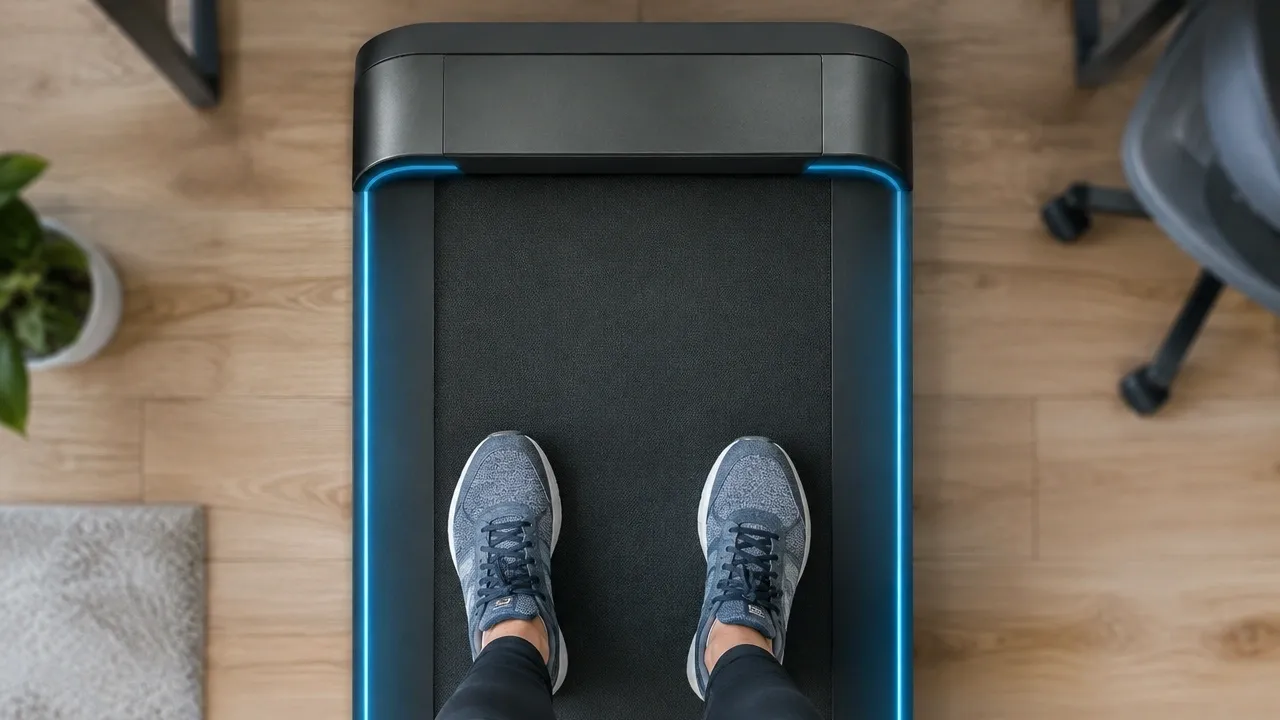
If you are shopping for a walking pad, the belt width is the most important safety spec you will check. After testing several models and talking to other users, I can give you a clear number.
For safe and comfortable walking, look for a belt width of at least 40 cm (15.7 inches). For most adults, 45 to 50 cm (17.7 to 19.7 inches) is the sweet spot.
Narrower belts under 40 cm are risky because your foot can easily step off the edge. Belts wider than 50 cm are rare on walking pads — you find those on full-size treadmills. Why 40 cm as the floor?
An average adult foot is about 10 cm wide. That leaves roughly 15 cm of margin on each side for your natural side-to-side swing while walking.
That margin keeps you centered even when you are distracted or walking at a faster pace. But your personal number might be different. Here is how to figure out what width actually works for your body.
Why Width Depends on Your Height and Stride
Taller people have wider hips and longer legs. This means their feet land farther apart naturally. If you are over 5 feet 10 inches, a 40 cm belt will feel cramped.
Your feet will constantly brush the sides, and you will instinctively shorten your stride to stay safe. Shorter users can often tolerate a narrower belt.
But they still need enough room to avoid scuffing the edges. Here is a rough guide based on height:
| Your Height | Minimum Belt Width | Comfortable Belt Width |
|---|---|---|
| Under 5′4″ (under 163 cm) | 40 cm | 42–45 cm |
| 5′4″ to 5′10″ (163–178 cm) | 42 cm | 45–48 cm |
| Over 5′10″ (over 178 cm) | 45 cm | 48–50 cm |
These numbers assume you are walking at a normal pace. If you plan to jog or run, add 5 cm to the minimum.
How Foot Size Affects the Safe Walking Surface
Shoe size matters more than most people realize. When you walk, your foot rolls from heel to toe.
At the heel strike, your foot is at an angle, which means the heel extends slightly beyond the center of your foot.
If your shoes are size US men’s 12 or women’s 10 or larger, that extra reach becomes a problem on a narrow belt. Here is a simple test you can do at home.
Put on the shoes you will wear on the walking pad. Stand on the floor and have someone mark the center of each heel. Measure the distance between those two marks. That is your stance width.
Now add 15 cm — about 7.5 cm on each side — for safe clearance. For example, if your stance width is 20 cm, you need a belt that is at least 35 cm wide.
That means 40 cm is safe, and 45 cm is comfortable.
The Myth of “Wider Is Always Better”
You might think a 55 cm belt is the safest choice. But on a walking pad, wider is not always better. Ultra-wide belts add significant weight.
A walking pad with a 55 cm belt often weighs 5 to 8 kg more than a 40 cm model. That extra weight makes the “portable” claim a joke.
You will struggle to move it under your desk or store it against a wall. Wider belts also increase the overall footprint of the machine. Many walking pads are designed to slide under a standing desk.
A belt that is too wide means the machine might not fit in the space you have. The correct width is a balance between safety and practicality. For most people, 45 cm is the sweet spot.
It gives you room to walk naturally without turning the machine into a bulky piece of furniture.
Safety and Gait Mechanics — What Happens With a Belt That’s Too Narrow
I have walked on a 38 cm belt, and I do not recommend it. Here is what happens when the belt is too narrow. Your brain constantly monitors where your feet are relative to the edge.
That mental load makes you walk stiffly. You shorten your stride and keep your feet closer together than normal. Over a 30-minute walk, this puts extra stress on your ankles and knees.
The lateral shear force — the sideways twisting motion — increases because your foot tries to stay centered. The real danger is stepping off. At slow speeds, you can catch yourself.
At a brisk walking pace, or if you get distracted by a phone call or typing, a misstep can send you off the side. That fall can cause sprains, fractures, or worse.
There is also the “40 cm trap.” Many budget walking pads advertise a 40 cm belt, but when you measure the usable surface, it is actually 39 cm or even 38 cm.
The difference comes from the frame edges that overhang the belt. Always check the usable width, not the deck width.
Look at the product images or ask the seller for the measurement from the inside edge of one side rail to the inside edge of the other.
How to Measure Your Personal Width Requirement
If you want to be sure before you buy, follow these steps. You need a tape measure and a floor with enough space to stand naturally.
- Stand on the floor with your feet shoulder-width apart, exactly as you would when walking.
- Have someone mark the center of each heel on the floor with a piece of tape or a small object.
- Measure the distance between the two marks. This is your stance width.
- Add 15 cm to that number. This gives you 7.5 cm of clearance on each side.
The result is the minimum belt width you need for safe walking. If you plan to walk for more than 30 minutes at a time, add another 2 to 3 cm for comfort.
Frequently Asked Questions
Is a 40 cm walking pad wide enough for jogging?
No. Jogging and running increase your lateral movement because your feet spend more time in the air. You need at least 45 cm for jogging, and 50 cm is better for running.
How does width affect noise and motor strain?
A wider belt places more load on the motor. If the motor is not rated for the extra surface area, it will strain and wear out faster. When comparing models, check the motor size.
A 2.5 CHP motor can handle a 45 cm belt easily, but a 1.0 CHP motor might struggle.
Can I use a walking pad if I have orthopedic shoes or custom insoles?
Yes, but your shoes are likely wider than standard athletic shoes. Orthopedic shoes can add 1 to 2 cm of width on each side. Test your shoes on the belt before you commit to a purchase.
If the sole extends beyond the edge of the belt during a normal step, you need a wider model.
Do foldable walking pads have the same width as non-foldable?
Usually yes, but the folding hinge can reduce usable width by 1 to 2 cm. The hinge mechanism sits on the sides of the deck, and it can narrow the walking surface slightly.
Check the specifications for the “usable belt width” rather than the “deck width.”
What about curved or non-motorized walking pads?
Curved walking pads often have a slightly wider belt, between 45 and 50 cm. This is because the curve changes your gait and you need more room to maintain balance.
Always measure the flat walking surface, not the curved portion.