How to Store a Walking Pad Upright

You can store a walking pad upright, but it is not a simple "set it and forget it" process. The manufacturer’s manual often warns against it for a reason. Gravity works against you.
The machine is top-heavy, and a falling 50-pound object can damage your floor, your wall, or worse, injure a person or pet.
However, if your apartment is small or you share an office, floor space is precious. I have stored my own walking pad upright for months.
It requires specific conditions and a little effort to do it right.
When Upright Storage Makes Sense
There are a few situations where storing a walking pad upright is the best option available to you. Your living space is a studio or a small apartment.
You have a standing desk setup in a shared room where floor clutter is not allowed. You have pets or small children, and a machine lying flat on the floor is a tripping hazard or a toy to climb on.
You use the walking pad in one room but need to store it in a narrow closet or behind a door. In these cases, vertical storage is not a bad habit—it is a necessity.
Which Walking Pads Can Be Stored Upright
Not every walking pad is built for this. You need to check your specific model before trying to stand it up. I learned this the hard way when I nearly tipped my own machine over on the first try.
Features that make upright storage possible: Built-in kickstand. Some models have a small metal bracket near the rear that flips out to brace the machine when vertical.
This is the safest option. If your pad has one, use it. Locking mechanism. A few high-end walking pads have a latch that locks the deck in an upright position.
This prevents the machine from sliding flat on its own. Low center of gravity. Machines with the motor mounted lower in the chassis are more stable when vertical.
If the motor is up front and high, the weight distribution works against you. Flat motor housing. A square or rectangular base provides a solid footprint.
Rounded or tapered bases wobble. If your pad is under 25 kg (55 lbs), you have a better chance of managing it safely.
Anything heavier requires serious caution unless the machine has a purpose-built stand.
How to Store a Walking Pad Upright Safely
If your walking pad lacks a built-in kickstand or locking mechanism, you must create a stable setup yourself. I use the following method for my own machine, which has no locking mechanism.
- Clear the area. Make sure the wall is flat and free of baseboard heaters or uneven trim. A smooth wall surface is your best anchor point.
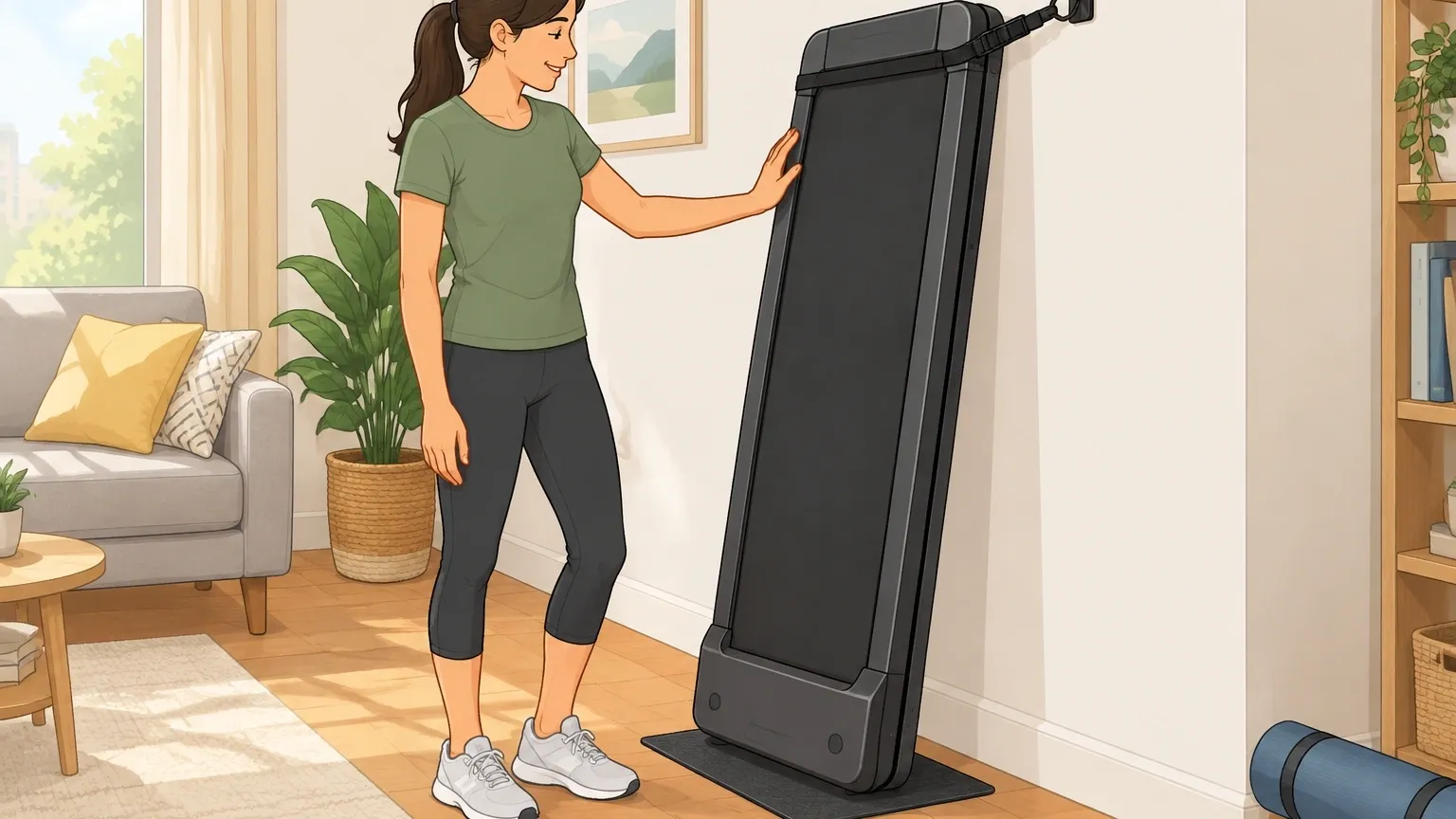
- Use a non-slip mat. Place a rubber or silicone mat where the base of the walking pad will sit. This stops the machine from sliding forward when you lean it against the wall.
- Lean it at a slight angle. Do not stand it perfectly vertical. A slight lean, about 5 to 10 degrees back toward the wall, shifts the center of gravity backward and makes it harder for the pad to tip forward.
- Secure the top. Use a ratchet strap or a heavy-duty bungee cord. Loop it around the front handle or the motor housing and attach it to a wall anchor or a sturdy piece of furniture. I use a simple hook screwed into a stud behind my desk.
- Test the stability. Gently push the walking pad from the front. It should not wobble or tip. If it moves, adjust the lean or tighten the strap.
What to Do If You Have No Wall Hooks
If you cannot drill into the wall, you have other options. A freestanding weight plate tree or a heavy dumbbell rack can serve as an anchor point. Loop your strap around the base of the rack.
Alternatively, place the walking pad between two heavy pieces of furniture, like a bookshelf and a sofa. The friction of being wedged in place can be enough, but you must test it every time.
How Long Can You Leave a Walking Pad Upright
This is a question I get from readers who want to store their pad for weeks or months at a time. The answer depends on the machine’s design, but there are general rules.
You can store a walking pad upright for a few days without any issue. For longer periods, you need to consider two things.
Motor oil. Many walking pads use a sealed motor bearing that relies on gravity to keep oil distributed.
If you store the pad vertically for months, the oil can slowly drain away from the bearings. When you lay the machine flat again, the bearings might run dry for the first few minutes.
I have seen this cause a temporary grinding noise. The fix is simple: lay the pad flat for an hour before using it to let the oil settle back.
I do not recommend storing any electric walking pad upright for more than three consecutive months. Belt tension. The walking belt is under constant tension when the deck is flat.
When you stand the pad up, the belt slackens. Over time, the belt can develop a sag or a memory of the folded shape. This can cause a thumping noise when you walk.
To prevent this, rotate the belt by hand every two weeks. Unplug the pad and spin the belt forward a few revolutions to redistribute the tension.
Dust accumulation. Vertical storage exposes the motor and the belt to dust falling from above.
Cover the walking pad with a sheet or a light tarp when storing it upright for more than a week.
DIY Upright Storage Solutions
If your walking pad does not have a kickstand, you can build one. A simple solution is a wooden or metal brace that props the machine at the correct angle.
Furniture sliders. These are useful if you need to move the walking pad in and out of a storage spot frequently. Place a pair of furniture sliders under the rear feet of the machine.
You can then tilt it upright, slide it against the wall, and secure it. The sliders make it easy to pull the pad back out when you want to use it.
Weighted base. If your walking pad is particularly top-heavy, you can add weight to the base to lower the center of gravity.
Use a sandbag draped over the rear of the machine, or attach a small dumbbell to the bottom frame with a strap. This is a non-standard modification, so test it thoroughly.
Frequently Asked Questions
Does storing a walking pad upright drain the battery?
No. Electric walking pads do not have a battery that drains when the machine is stored. They only draw power when the motor is running and you have the remote connected.
Standing the pad upright does not affect the electrical system.
Can I store an incline-capable walking pad upright?
Yes, but you need to retract the incline mechanism completely. If the incline is raised, the machine is unstable and may tip. Always fold the incline flat before standing the pad up.
Some incline models have a locking mechanism that only engages when the deck is flat, so check your manual.
Will storing upright void the warranty?
It can. Most walking pad warranties require the machine to be stored flat and on a level surface.
If you store it upright and the motor fails or the belt is damaged, the manufacturer may deny your claim. Read the warranty document carefully.
If it says "Do not store vertically," you are taking a risk.
I recommend storing the machine flat for the first year of ownership to protect the warranty, then switching to upright storage after that period if you are comfortable.
How do I safely move an upright walking pad from one room to another?
Do not wheel it upright. The wheels on most walking pads are designed to move the machine forward and backward when it is flat.
Moving it upright puts all the weight on two small wheels and makes the machine unstable. Lay the pad flat first, then roll it to the new location.
If you absolutely must move it upright, have a second person support the top. Walk slowly and keep the machine tilted slightly backward.