Does Walking Pad Build Muscle

If you bought a walking pad hoping for bigger calves or stronger glutes, you might be disappointed – or pleasantly surprised, depending on how you use it.
The honest answer is that a walking pad alone, at a slow, flat pace, will not build noticeable muscle. But that doesn’t mean it’s useless for muscle.
With the right tweaks, you can turn a walking pad from a step-counter into a tool that actually challenges your legs.
This article explains the physiology behind why walking normally falls short, which muscles get any work, and exactly how you can modify your walking pad routine to encourage minor muscle growth.
You’ll also learn where walking pads fit into a bigger strength-training plan.
Why Walking Normally Does Not Stimulate Muscle Growth
Muscle growth – hypertrophy – happens when you force your muscle fibers to work harder than they are used to. This is called progressive overload.
Typically, you need to lift a weight that is about 60 to 70 percent of your maximum effort.
Walking at a comfortable 2 to 3 miles per hour on a flat surface uses only about 20 to 30 percent of your maximum effort. That is not enough mechanical tension to trigger growth.
Walking also relies mostly on slow-twitch muscle fibers (Type I). These fibers are built for endurance, not size.
They resist fatigue and use oxygen efficiently, but they have very little potential for getting bigger.
To grow muscle, you need to recruit fast-twitch fibers (Type II), which fire during explosive, heavy efforts like sprinting or lifting.
Even if you walk for 10,000 steps every day, your muscles adapt to the low effort and stop changing.
The only way to see new muscle is to increase the demand – and that means changing how you walk on the pad.
The Muscles That Walking Pad Actually Activates
Flat walking at a moderate pace does activate some muscles, but at very low levels. Here is a breakdown of the main movers and how hard they work compared to a typical strength exercise:
- Calves (gastrocnemius and soleus): These push you forward. Activation is about 30 to 40 percent of what you'd get from standing calf raises. Walking alone will not grow your calves, but it will maintain them.
- Hamstrings: They help control your leg swing. Activation is around 20 percent of a leg curl. Not enough for growth.
- Gluteus maximus: Surprisingly low. Flat walking activates the glutes at only 15 to 20 percent of a squat. Your butt stays mostly relaxed because your hip does not need to extend much.
- Hip flexors: These lift your leg. They get mild activation but no overload.
- Tibialis anterior: The shin muscle works to keep your foot from slapping down. It gets a small endurance benefit.
None of these muscles experience enough tension to grow. The only way to change that is to increase the incline, speed, or load.
Can You Modify a Walking Pad to Build Muscle
Yes, but with limits. You cannot turn a walking pad into a leg press, but you can shift the stimulus enough to encourage minor strength gains and muscle endurance in the calves, hamstrings, and glutes.
The following strategies are based on progressive overload principles.
Incline Adjustments
Incline is the single most effective modification. Every degree of incline increases the load on your posterior chain – glutes, hamstrings, and calves – by about 30 percent.
At a 5 to 8 percent grade, your glute activation can double compared to flat walking. Start at a 3 percent incline at 2.5 mph for 20 minutes.
Each week, increase the incline by 1 to 2 percent or add a minute to your walk. At 8 percent and 3 mph, your glutes will work at roughly 50 to 60 percent of a bodyweight squat.
That is enough to stimulate some growth if you are a beginner or have been sedentary.
Speed Variations and Intervals
Brisk walking – 3.5 to 4 mph – pushes your heart rate up and recruits more fast-twitch fibers in your calves and hip extensors. But steady speed alone still lacks overload.
The better approach is intervals: walk 2 minutes at 3.5 mph (or as fast as you can control without holding rails), then 1 minute at 2 mph. Repeat for 20 to 30 minutes.
Intervals increase mechanical tension because your muscles have to accelerate quickly. This is closer to sprinting than to steady walking.
Over 8 to 12 weeks, you might notice your calves feeling firmer, but do not expect the size change you would get from jumping rope or running.
Added Weight
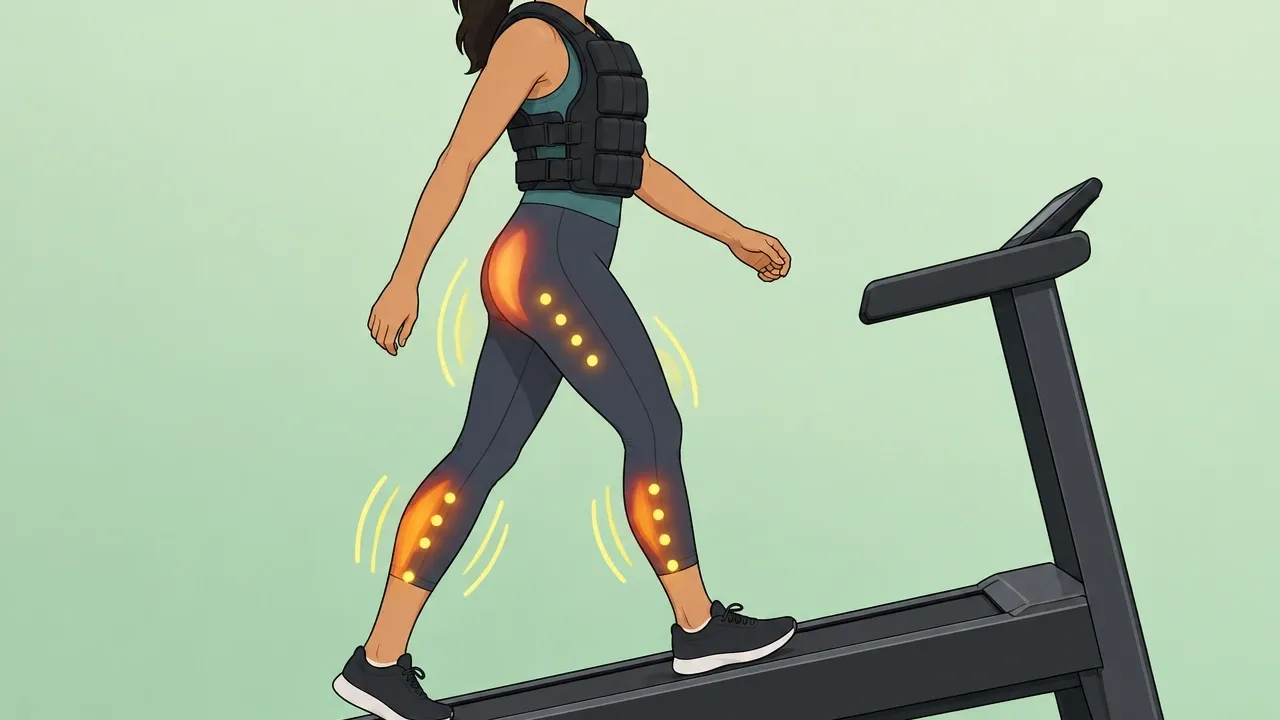
Wearing a weighted vest (10 to 20 percent of your body weight) converts walking into a moderate-load exercise.
Your legs have to push against extra mass, which increases ground reaction forces and muscle activation. A vest also adds compressive load to your spine and hips, which helps maintain bone density.
Safety is important: start with 5 percent of body weight and walk flat at a slow pace for 10 minutes. Increase weight gradually only when you feel stable. Avoid letting the vest bounce or shift.
With a weighted vest at 15 to 20 percent of body weight and a 5 percent incline, your quadriceps and glutes will work at roughly 60 percent of a bodyweight squat – enough for beginner muscle gains.
Unilateral Movements
Side-stepping on the pad targets your gluteus medius and adductors, which often get ignored during forward walking.
But these moves are not sustainable for building mass – they work best as a warm-up or activation drill. Set the speed to 0.5 mph, turn sideways, and take 30 to 60 second steps per side.
It will wake up your hips but not grow them. Backward walking (facing away from the console) shifts more load to your quadriceps and tibialis anterior.
Do it at a very slow speed (0.5 to 1 mph) and only if you feel confident balancing. Again, this is more for rehab or activation than hypertrophy.
Walking Pad vs. Strength Training for Muscle
Walking pads are not a replacement for leg day. The differences are mechanical and hormonal:
- Mechanical tension: Strength training provides eccentric loading (lowering a weight) and high concentric force. Walking provides only low concentric force with almost no eccentric overload.
- Hormonal response: Heavy squats and deadlifts trigger a surge in growth hormone and testosterone that supports muscle repair. Walking does not produce this hormonal spike.
- Muscle fiber recruitment: Strength training recruits 100% of available motor units in a muscle. Walking rarely recruits more than 40%.
That said, walking pads complement strength training. They increase non-exercise activity thermogenesis (NEAT), which helps with fat loss while preserving muscle.
They also serve as active recovery – a light walk on a rest day improves blood flow and reduces soreness from heavy lifting.
The best results come from walking pad sessions between your real leg workouts.
Realistic Muscle Outcomes from Walking Pad Use
What you can expect depends on who you are:
- Sedentary beginner: After 4 to 6 weeks of walking at 3.5 mph with a 5% incline and a weighted vest (10% body weight), you may notice your calves and glutes feel firmer. This is mostly due to increased muscle endurance and fat loss, not new muscle mass. True hypertrophy will be minimal unless you also increase calories and protein.
- Active individual: You will not gain noticeable muscle from a walking pad. Your legs are already used to harder work. You might improve your walking economy and stamina, but you won't add size.
- Elderly or rehab population: Walking pads help maintain muscle mass and prevent sarcopenia when combined with resistance bands or bodyweight squats. The low impact is ideal for joint safety.
- Role of nutrition: Without a caloric surplus (or at least adequate protein – 1.6 grams per kilogram of body weight), hypertrophy is impossible regardless of walking protocol.
Myths and Misconceptions About Walking Pads and Muscle
Several common beliefs need correction:
- “Walking tones legs without bulking.” Toning is not a real physiological process. You either lose fat (which makes muscles look more defined) or gain muscle. Walking alone rarely does either in a meaningful way.
- “Walking pads replace leg day.” No. Leg day involves squats, lunges, hip thrusts, and deadlifts – movements that load the muscles with 80 to 100% of your one-rep max. A walking pad cannot replicate that.
- “Incline walking builds glutes like hip thrusts.” Even at a 15% incline, glute activation is about 60% of a hip thrust. That is not enough tension to stimulate growth unless you are a complete beginner.
- “Side-stepping builds outer thigh muscle.” It activates glute medius, but building that muscle requires progressive overload with added resistance bands or weights. Side-stepping on a pad at 0.5 mph provides very low load.
Frequently Asked Questions
Can walking on a walking pad give you bigger calves?
Only if you add significant speed (above 3.5 mph) or incline (above 5%). Otherwise, walking maintains calf size but does not grow them.
For calf growth, standing or seated calf raises are far more effective.
Does walking pad help with muscle recovery after leg day?
Yes. Low-intensity walking increases blood flow to sore muscles and reduces delayed onset muscle soreness without adding fatigue.
Walk at 1.5 to 2 mph for 15 to 20 minutes on a flat surface for best results.
Will a walking pad help me lose fat while preserving muscle?
Yes – if you walk at a steady, low intensity (around 2 to 3 mph) and maintain a calorie deficit with adequate protein.
Walking preserves lean mass better than sitting, but you still need resistance training to maintain muscle.
How long should I walk on a walking pad to see muscle changes?
For a beginner using incline (5%+), brisk speed (3.5 mph), or a weighted vest, you need at least 30 to 40 minutes, five times per week, for 8 to 12 weeks to observe minor improvements in calf and hamstring endurance.
Visible muscle growth is unlikely.
Can I use a walking pad if I have knee pain and want to strengthen legs?
Yes. Walking pads are low impact. Start flat at a slow speed (1.5 mph). Gradually add incline to strengthen your quadriceps and hamstrings without pounding your knees.
If pain increases, stop and consult a physical therapist. Walking pads are excellent for daily movement, recovery, and maintaining a baseline of fitness. They are not muscle-building machines.
But with careful adjustments – incline, speed, intervals, or a weighted vest – you can nudge them into the gray zone where they provide enough stimulus for small strength gains in your lower body.
Just keep your expectations grounded: real muscle growth still requires heavier resistance work.
Use a walking pad for what it does best – letting you move more every day – and save the heavy lifting for the gym floor.