Are Walking Pads Manual or Electric?

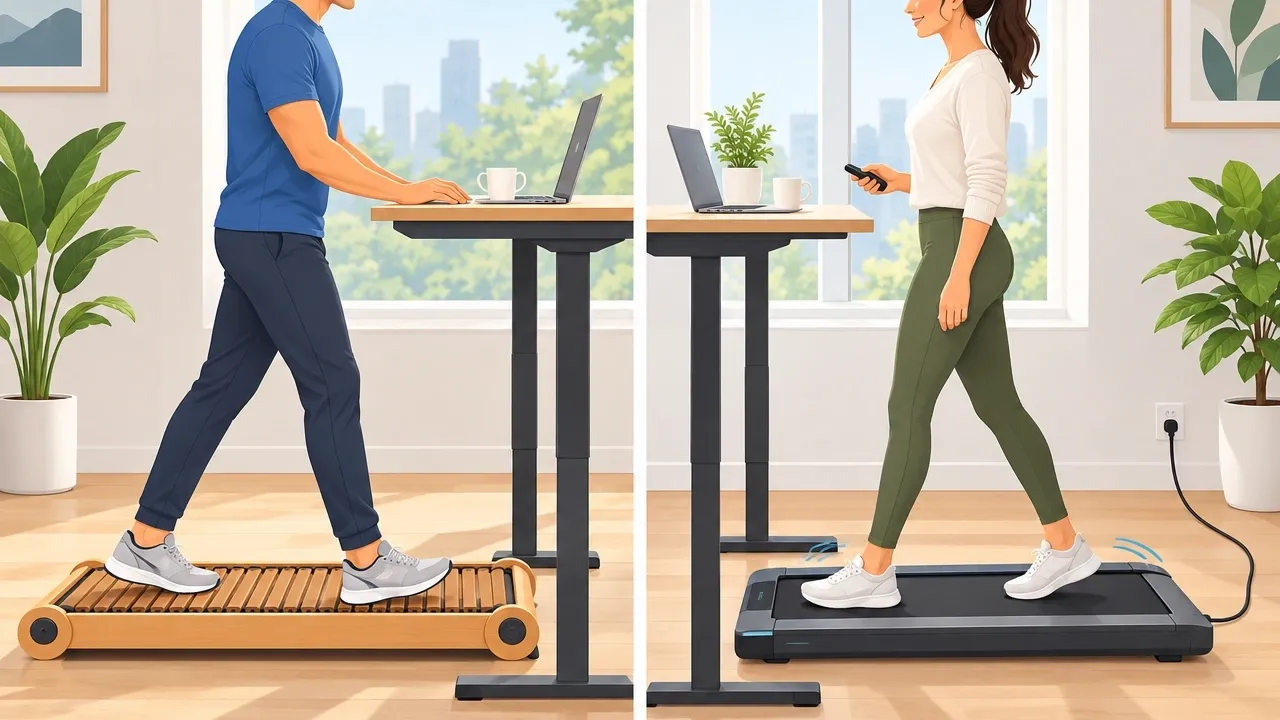
Walking pads come in both manual (self-propelled, no electricity) and electric (motor-driven, plug-in) versions.
The right choice depends primarily on three factors: your workflow tolerance (can you self-start enough to push the belt?), your space and noise constraints, and your long-term cost outlook.
Below we break down exactly how each type behaves so you can decide.
What is a Manual Walking Pad?
A manual walking pad has no motor. You move the belt entirely with your own footsteps.
There are two main designs: wooden slat pads (like the Walkolution or Office Walker) that use a subtle curved deck and ball bearings, and steel curved-belt pads (like the ERGOLIFE or RongLe) that use a deep curve with magnetic resistance.
In both cases, you control the pace actively. This means you cannot zone out – you must maintain a steady stride to keep the belt moving.
Manual pads require a short adaptation period. During the first few sessions, your legs may feel awkward as they learn to drive the belt smoothly.
After a week or so, most users report the motion becomes natural.
Because there is no motor, manual pads are quieter than electric ones, but they still produce sound – typically a soft thumping from slats or a low rumble from the steel belt.
Manual pads cost more upfront (typically $700 to $1,400 for desk-friendly models), but they have almost no moving parts to wear out.
The main maintenance is occasional bearing lubrication and dust removal.
What is an Electric Walking Pad?
An electric walking pad uses a motor to drive the belt. You set the speed using a remote or console, then simply walk at that pace.
This is a passive experience – you can read, type, or zone out while the machine does the work. Most electric pads top out at 4 to 6 mph, which is fast walking but not running.
Electric pads are cheaper upfront – usually $200 to $600. But they come with ongoing costs. You need to lubricate the belt, adjust tension, and replace the drive belt every 6 to 12 months.
The motor itself has a finite lifespan, typically 2,000 to 5,000 hours. After that, replacement may cost as much as a new machine. They also use electricity – about 2 to 4 cents per hour of walking.
Noise is another factor. Electric pads produce a constant motor hum and a whir from the belt. This can be annoying in quiet spaces like shared offices or thin-walled apartments.
The Real Deciding Factors: Context Over Specs
Specs like speed range and weight capacity matter, but the real choice depends on your personal situation. Here are three factors that most articles skip.
Your Environment and Proximity
Where will you use the walking pad? In a home office with a partner in the next room? In a shared apartment with thin walls? The type of noise matters.
Electric pads produce a continuous low-frequency hum that travels through walls. Manual pads produce a rhythmic thumping (from slats) or a deeper rolling sound (from curved steel).
Neither is silent, but the manual hum is less likely to bother a roommate because it is intermittent and softer at slow speeds.
If you share a space with someone who works or sleeps nearby, try to test both types first.
Your Work Style and Self-Motivation
Are you someone who likes to set a routine and forget about it? Then an electric pad works well – you pick a speed and walk without thinking.
But if you tend to hyperfocus and need a gentle nudge to stay active, a manual pad may actually help. The active effort of pushing the belt can keep you from slouching or drifting off.
That said, the cognitive load of driving the belt can interfere with tasks that require intense concentration, like writing or coding.
A Stanford study found creative output increased 60% while walking on a flat outdoor path, but that was not on a manual curved belt.
The extra mental effort of a manual pad might cancel focus gains for some people. If possible, try a manual pad before buying.
Longevity and Resale Value
Electric pads lose value quickly because the motor is a wear item. After two years, an electric pad might sell for 30% of its original price.
Manual pads, especially wooden ones, hold their value much better – often 60-70% of the original cost after two years because they can be fully refurbished.
The simple construction means fewer failure points. If you plan to use the pad for years or think you might resell it, a manual pad is the better investment.
Total Cost of Ownership
Here is a quick comparison over three years.
| Cost Category | Electric Pad | Manual Pad |
|---|---|---|
| Upfront cost | $400 (average) | $1,100 (average) |
| Yearly maintenance | $50 (lube, belt, tune-ups) | $10 (bearing grease) |
| Yearly electricity | $25 | $0 |
| Total after 3 years | $625 | $1,130 |
| Resale value after 3 years | $120 (30% of upfront) | $660 (60% of upfront) |
| Net cost after 3 years | $505 | $470 |
After three years, the manual pad actually becomes cheaper. If you plan to walk daily for several years, the manual pad wins on cost.
If you only want to experiment for a few months, the electric pad is cheaper.
What No One Tells You About Moving to a Manual Walking Pad
If you switch from an electric to a manual pad, expect these surprises.
- First few minutes feel heavy. The belt will feel stuck or too hard to push. This is normal. After three to five sessions, your legs adapt and the resistance feels natural.
- Your focus will actually improve after the first week. The first three days you might keep looking at the belt, wondering if you made a mistake. Stick with it. Once the motion becomes automatic, many people find it easier to concentrate than on an electric pad because there is no motor noise to distract them.
- You need to stand slightly tilted forward. If you stand upright, the belt won't move smoothly. A slight lean forward from the ankles keeps the belt rolling.
- No safety key. Electric pads have a magnetic key that stops the belt if you pull it off. Manual pads have no such feature. If you stumble, you must stop the belt with your own feet. This takes practice. Start slow and keep your hands near a desk edge for balance.
Frequently Asked Questions
Can I use a manual walking pad on carpet?
It depends. Wooden slat pads often have small wheels that dig into thick carpet and void the warranty. Steel curved-belt pads need a flat hard surface for stability.
Most manufacturers recommend using a mat on carpet. Check your model's warranty terms before placing it on carpet.
Do manual walking pads require any maintenance at all?
Yes, but less than electric pads. You need to occasionally lubricate the bearings, check belt alignment, and remove dust from slat channels. There is no motor to lubricate or drive belt to replace.
A manual pad can last decades with basic care.
Are walking pads safe for seniors or people with balance issues?
Electric pads are safer because you can stop instantly with a remote. Manual pads require active step control – if you lose balance, you have to stop the belt with your feet.
Very few manual pads include handrails for under-desk use. If you have balance concerns, start with an electric pad and a low speed.
How much electricity does an electric walking pad actually use?
Typical electric pads draw 0.15 to 0.25 kWh per hour of walking. At average US electricity rates, that costs about 2 to 4 cents per hour. Not much, but it adds up over years of daily use.
Can I walk backwards on a manual walking pad for variety?
Yes, but it is awkward on curved steel belts and slightly easier on wooden slats. Even then, it is not recommended without hand support because the risk of tripping is higher.
If you want variety, stick to forward walking or use a separate exercise routine.