Why Your Under Desk Treadmill Clicks or Grinds and How to Fix It


If you're here because your under desk treadmill is making a clicking or grinding noise, you're in the right place. A clicking walking pad is annoying.
A grinding one is genuinely worrying, because a part of you already knows it won't fix itself.
I've worked with enough compact treadmills to tell you the truth up front: most clicks are harmless, and most grinds are not.
Here are the two things you need to understand before anything else.
First, most clicking sounds come from the belt seam passing over the front roller or from a small piece of debris stuck in the belt path. Both are normal or easily solved.
Second, a grinding sound almost always means a worn bearing or a failing motor part, and it will not heal with time, lubricant, or hope.
This guide walks you through the full journey: how to read the sound, what you can check in five minutes, what's actually inside the machine creating these noises, and the question no other article seems to answer honestly — whether it's worth fixing at all.
Spoiler: for many budget walking pads, the smart move is to replace the unit, not repair it.
Read the Sound First: What Each Noise Is Actually Telling You
Before you do anything, listen. Not just to the noise itself, but to its rhythm, its pitch, and where it's coming from. The pattern matters much more than the volume.
A rapid tick at low speed and a deep thump with each footstep point to completely different problems.
| Sound | What It Usually Means | How Serious Is It? |
|---|---|---|
| Clicking or ticking | The belt seam passing over the rollers, debris trapped in the belt path, or a loose plastic guard. | Low. Safe to keep using for a short time while you investigate. |
| Clunking or thumping | A stiff spot in the belt, a flattened roller, or early bearing wear on the front roller. | Medium. Worth checking, but it won't stop working today. |
| Grinding or scraping | A failing motor bearing, a worn drive roller bearing, or the motor encoder rubbing internally. | High. Stop using the machine. |
One important warning. If the grinding sound comes together with a burning electronics smell, unplug the machine and do not turn it back on.
That combination means the motor is overheating, and continued use can destroy the controller board, the motor, or both.
If you are hearing steady grinding right now, skip ahead to the repair-versus-replace decision, because none of the home fixes in this article will bring a worn bearing back to life.
The 5-Minute Owner Check Before You Panic
Every table and technician on the internet will tell you to start inspecting the machine. But almost everything you read applies to full-size treadmills with accessible parts.
A walking pad is different, and so are the first things you should check. These five steps require no tools, take under a minute each, and do not void your warranty.
Do them in order, and you might solve the problem before this article gets long.
- The location test. Your walking pad is light. If it sits on a rug, even a thin one, it will rock slightly with each step. That rocking translates into a rhythmic clicking vibration that sounds exactly like a mechanical fault. Move it to a hard, flat floor, press down on each corner to confirm it doesn't rock, and test it again. This one check solves more mystery noises than any other.
- The weight test. Walk on the front half of the belt, then on the back half. A click that only appears at the front is usually the belt seam hitting the front roller. A click that appears at the back is often a bit of debris that has migrated into the rear roller. If the noise stays the same no matter where you stand, something in the rotating system is the cause, which points toward a roller or motor issue.
- The visual belt sweep. Unplug the unit. Lift the edge of the belt along one side and look inside. A paperclip, an earring, a clump of dust — all of these get pulled into the belt path and produce a sharp click with every rotation. Run a dry cloth under the belt in a sweeping motion to push out anything hiding there. Don't use water or a cleaning spray; a dry cloth is enough.
- The empty belt test. Run the belt at the lowest speed with no weight on it and listen carefully. If the clicking continues with no load, it's rotational — the sound comes from something spinning. If the clicking only appears when you stand on it, it's load-related flex: the weight of your body pushes the rollers slightly out of alignment. That's common on budget machines, and it's not a sign of imminent failure.
- The break-in rule. If the walking pad is brand new, under two weeks old, this changes everything. The belt needs to seat itself onto the rollers, and that process takes a few miles of walking. A clicking sound that appears on a new unit and slowly fades over the first several sessions is not a defect. It's the belt seating. Give it time before you give up on it.
Inside the Walking Pad: Where the Sounds Come From
If the quick checks didn't solve it, the noise is coming from deeper inside. This is where generic treadmill articles fail you.
They tell you to lubricate the belt and adjust the rollers because full-size treadmills have those parts. Walking pads do not.
Here's what your machine actually has under the hood, and how each component produces its own signature sound.
The Belt Seam and the Front Roller
Every belt on a walking pad is a loop, and that loop has a splice — a seam where the two ends of the material were fused together. On expensive treadmills, that seam is sanded flush at the factory.
On a budget walking pad, it's a barely visible ridge. As that ridge passes over the front roller, which is small and often under 40mm in diameter, it produces a tick. One tick per revolution.
That is your clicking noise.
There's no fixing this, because there's nothing broken. The seam is part of how the belt was made.
If the clicking is rhythmic, faint, and matches the belt speed, this is almost certainly what you're hearing.
It's not a defect; it's the machine working as designed, and the design just happens to be audible.
The Motor Encoder and Controller
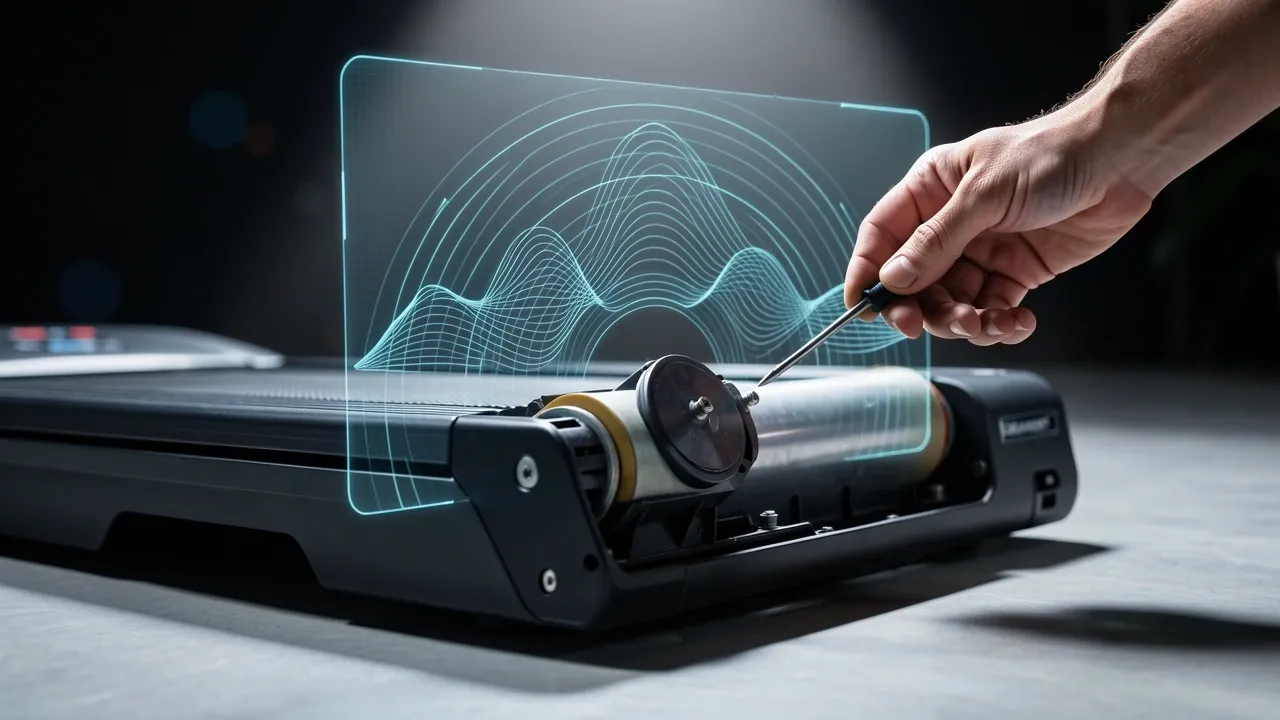
Some clicking doesn't come from the belt at all. Under desk treadmills run for hours at very low speed, and the motor uses a small magnetic sensor wheel called an encoder to measure rotation.
At low RPM, that encoder can produce a rapid, faint clicking that sounds like a plastic zipper. It's fast, it's steady, and it doesn't change with your weight or your position on the belt.
This is not something you can fix at home, and it's also not a reason to panic. If the machine runs smoothly and the only symptom is a quiet zipper-like click, the encoder is doing its job.
You can ignore it and keep walking.
The Drive Roller Bearings and Motor Bushings
Here's the serious one. Grinding is metal rubbing against metal. Inside the rear roller and the motor housing, there are small sealed bearings packed with grease.
Once that grease dries out, or the bearing's metal race cracks, the bearing wears down quickly. The resulting sound is a steady grind that gets worse with every mile you put on it.
You can tell which part is failing by shifting your weight. Step to the back of the belt. If the grinding gets louder or changes pitch, it's a rear roller bearing.
If the pitch stays constant no matter where you stand, it's the motor bearing or the motor bushing. That distinction matters because it changes your decision about whether to repair or replace.
The Drive Belt vs. Direct Drive Distinction
One more piece of vocabulary. Full-size treadmills use a rubber drive belt to connect the motor to the front roller.
Most walking pads use direct drive — the motor shaft goes straight into the roller with no secondary belt.
A few models do use a small drive belt, and those are the ones that can develop a clicking sound from a worn or loose belt slipping over a pulley cog.
How do you know which one you own? Check the manual's exploded diagram, or simply look at the machine with the casing visible after unplugging it.
If the motor sits inline with the front roller, it's direct drive.
If there's a separate pulley and a thin loop of rubber, it's belt-driven, and that belt deserves a visual inspection for cracks or slack.
The Maintenance Myth That's Destroying Your Walking Pad
Here is the chapter every other article is missing, and it's the one that causes the most damage.
Search the internet for "treadmill making noise" and every single result will tell you to lubricate the belt. That advice was written for full-size treadmills with a serviceable deck.
Your under desk treadmill is a completely different animal, and following that advice will make your problem worse.
Never lubricate a sealed walking pad.
Your walking pad comes from the factory with a pre-lubricated, wax-based belt. There is no lubrication port, no tension adjustment, and no access to the deck without opening a glued-together casing.
If you pry that casing open, you will leave visible marks. Those marks are exactly what manufacturers look for when they reject warranty claims.
You end up with a broken machine and no coverage, which is the worst possible outcome.
Worse still, adding silicone spray to the belt makes the belt lose traction.
It starts slipping, and you develop a new noise — a grip-and-release squeal, sometimes called belt creep — that never existed before. You applied the fix, and the fix created the problem.
I've seen people lubricate their walking pad into an early grave because a generic article told them to.
Here's the rule to live by: if you can't wipe it or tighten it with an Allen wrench from the outside, don't touch it.
Treat your walking pad like a sealed appliance — a toaster with a belt — not a serviceable treadmill. This mental shift will save you more money than any repair guide ever will.
To Repair or Replace? The $200 Rule
Now let's talk about money, because the repair-versus-replace question is the one that actually matters, and it's the one nobody answers. Diagnosing a walking pad is easy. Finding parts is hard.
Most budget walking pads do not sell spare motors, roller bearings, or controller boards to consumers. The few parts you can find online are generic and may not match your model.
And if you call a technician, you're paying for their time whether they fix it or not.
Here is the rule I use whenever someone asks me what to do: if the repair quote is anywhere close to half the replacement cost, replace the machine.
The math rarely works out in favor of repair for a budget unit.
You should repair it if:
- The unit is still under warranty and the noise is clearly a manufacturing defect.
- You paid more than $600 for it. Higher-end walking pads have better parts and are worth a real repair.
- The problem was minor, like debris removal or leveling the machine.
Stop and replace it if:
- The grinding persists after all the 5-minute owner checks are done.
- The unit is out of warranty and more than a year old.
- The replacement cost of the same model is under $300.
Do the math out loud. A technician's diagnostic fee is around $80. A replacement motor, if one exists at all, runs $50 to $70. Labor is $100.
That's over $200 for a repair with no guarantee, versus a brand-new machine for $250 to $300 that comes with a fresh warranty. You don't need a calculator to see which one makes sense.
That's the $200 rule, and it's saved me from wasting money more times than I can count.
I'll give you the blunt version. If you're standing over a grinding walking pad that's 18 months old, unplug it, recycle it, and buy the upgraded model.
Your time is worth more than this repair, and the new unit will be quieter, with a warranty that covers your peace of mind.
How to Keep a New Under Desk Treadmill Quiet for Years
Whether you kept your current walking pad or bought a new one, these habits will keep it running quietly for much longer.
The routine takes five minutes a week, and every item on this list targets a specific noise source we've already covered.
- Weekly. Wipe the edges of the belt and the floor beneath the machine with a dry cloth. Debris caught in the belt path is the number one cause of clicking, and preventing it takes five seconds.
- Monthly. Unplug the unit and clean around the front roller cap, the area where the belt loops over the roller. Dust and hair gather there and can develop into a squeak over time.
- Monthly. Confirm the machine sits level on a hard surface, especially after moving it. A slight rock translates into a clicking vibration that sounds exactly like a mechanical fault.
- Every 3 months. If your manual shows an external motor lubrication port, apply a dry PTFE lubricant there and only there. If there's no port, don't go looking for one.
- Every 6 months. Run the belt at maximum speed with nobody on it for five minutes. This resets the belt's natural moisture balance and prevents flat spots, which are what cause thumping noises.
Frequently Asked Questions
Why does my under desk treadmill click only when I'm standing on it?
That's load-related flex. When your weight presses down, the rollers flex slightly and the belt tension shifts.
A belt seam that passes quietly over the front roller under no load becomes an audible tick under load. It's common on budget machines, and it is not a sign of imminent failure.
Why does my walking pad make one loud click at startup and then run fine?
That's the motor controller relay engaging. The component works like a small switch that sends power to the motor, and it makes a single mechanical click every time it engages.
It's completely normal, purely electrical, and not a cause for concern.
Is it safe to use an under desk treadmill that grinds?
No. Grinding means metal-on-metal friction, which generates heat.
Running the machine risks overheating the motor, damaging the controller board, or having the belt stop suddenly while you're standing on it.
Unplug the unit and don't use it until you've decided whether to repair or replace.
Can I tighten the belt on my walking pad to stop the clicking?
On most under desk models, no. The belt tension is fixed at the factory, and the rear adjustment screw, if present, controls tracking only, not tension.
Over-tightening it can damage the sealed roller assembly. Only adjust if your manual specifically shows a visible tension hex bolt, and even then make half-turn adjustments at most.
Do all under desk treadmills eventually make a clicking noise?
Most of them, yes. Walking pads have a realistic lifespan of roughly 500 to 1,500 miles of walking, depending on build quality.
As the belt wears and the seam fibers loosen, a faint click becomes part of the machine's normal sound. It's not a defect; it's the product aging the way it was designed to.