How to Safely Step On and Off a Moving Under-Desk Treadmill Without Losing Balance

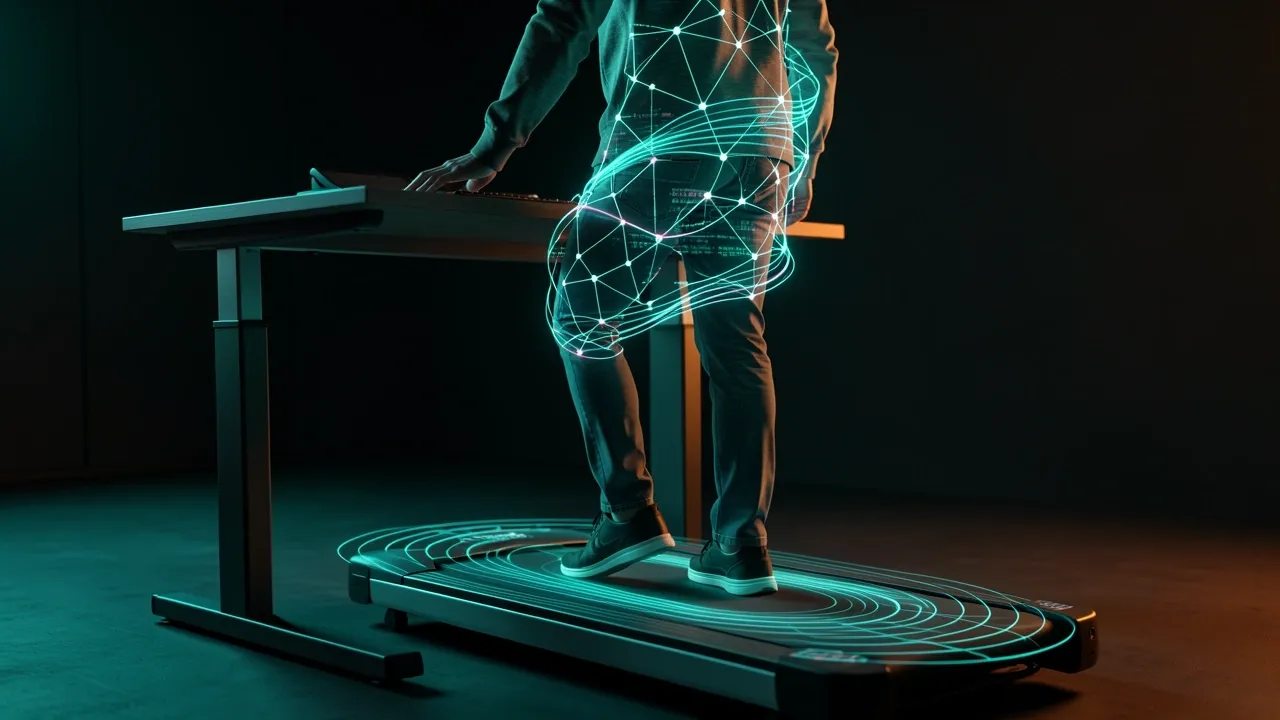
If you have ever asked how to safely step on and off a moving under-desk treadmill without losing balance, you already know the moment of panic when the belt starts sliding beneath your feet.
Your body freezes, your hands grab the nearest surface, and your brain tries to make sense of which direction is safe.
I have spent hundreds of hours on a treadmill desk, and I learned these moves the hard way. It does not have to be that scary.
There is one rule that changes everything: never step onto a moving belt. The belt moves toward you while your balance system expects the ground to stay still.
Those two signals clash, and that clash is exactly why falls happen. Stopping the belt first is always the safest option, whether with the remote, the stop button, or unplugging the machine.
But real life at a treadmill desk does not always cooperate. The remote might be across the desk, the stop button could be out of reach, or you might be mid-task and need to step on quickly.
For those moments, this guide walks through the exact footwork, hand placement, and mental cues that get you on and off safely, without wobbling or rushing.
It also covers what to do when you stumble, because knowing how to recover is just as important as knowing how to step.
Why Stepping Onto a Moving Belt Makes You Unsteady
Stepping onto a moving belt feels wrong because your body's balance system is built for solid ground.
Three systems normally work together to keep you upright: your inner ear, your eyes, and the sensors in your muscles and joints. When you stand on a treadmill that is off, all three agree.
When the belt moves, they stop agreeing.
Your feet feel the belt sliding backward beneath you, but your eyes see a room that is not moving. Your inner ear tells you you are standing still.
That mismatch produces a disorienting, unsteady feeling that has nothing to do with how fit or coordinated you are. It is your nervous system doing its best with conflicting information.
There is also a mechanical side. When one foot lands on the moving belt while the other stays on the stationary rail, your center of mass sits between two surfaces moving at different speeds.
Your body has to shift its base of support instantly to stay upright. That instant of adjustment is where most falls begin.
Fear makes it worse. When you are nervous about falling, your muscles tense, your breathing shortens, and your center of gravity rises.
Tight muscles react more slowly than relaxed ones, and the fear itself can trigger the stumble you were trying to avoid. The goal is to interrupt that cycle with deliberate, predictable movements.
The Safe Mounting Sequence
The mounting process comes down to one idea: give your body time to adjust and keep your weight low and centered. The steps below walk you through each stage, with the reason behind every move.
- Set the belt speed at its lowest setting. If your treadmill starts fast, use the speed controls to bring it down to a crawl before you put a foot near it. At speeds below1 mph, the belt's motion is slow enough for your brain to process what your feet are feeling. At speeds above2 mph, the window for safe transition nearly disappears. Most under-desk treadmills start around0.5 mph — that is your boarding speed.
- Use two-point contact. Place both hands on something stable: the desk edge, a heavy chair back, or a wall. If your treadmill has handrails, use them. Keep your grip light, not tense, because the hands are there to steady you, not to hold your full weight.
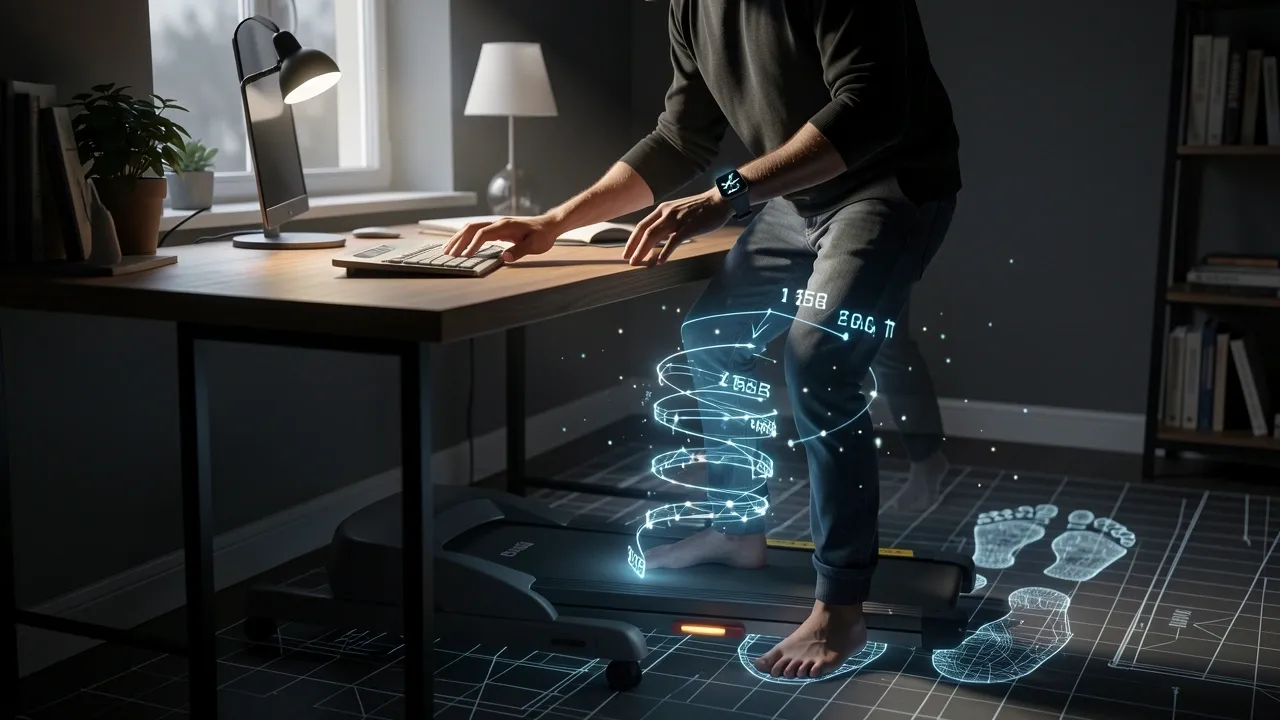
- Position your feet correctly. Stand with both feet on the stationary side rails, shoulder-width apart, knees slightly bent. A wider base gives you a larger margin of error, and bent knees lower your center of gravity so you can absorb the push of the belt when you step on.
- Start with your dominant foot. Place your dominant foot onto the moving belt first, keeping the ball of your foot planted and your weight spread evenly across the foot. Hold that position for two or three seconds. Let your brain catch up to the sensation before you do anything else. That pause is your buffer against the fall.
- Transfer weight and bring up the second foot. Shift your weight slowly from the stationary foot to the belt foot. Lift the stationary foot and place it beside the first. Keep your eyes on a fixed point at eye level straight ahead. Do not look down at your feet.
- Find your stride. Once both feet are on the belt, let your body settle into the motion. Keep your knees soft, avoid taking steps that are too long, and let the belt carry your foot backward before you lift it forward. Stay focused on that fixed point ahead for the first30 to60 seconds until you feel steady.
No Handrails?
Most under-desk treadmills do not have handrails. That is part of what makes them easy to slide under a desk. But it also means you need a backup support point before you step on.
Pick an emergency touch point — the desk edge, a heavy chair, or a wall within arm's reach — and plan your boarding around it. Never board a railless treadmill without a supportive surface close by.
The Safe Dismounting Sequence
Getting off presents the opposite problem. Your body has adapted to the moving belt, and stepping back onto stationary ground triggers the same sensory confusion in reverse.
The same principles apply: slow down, hold on to something, and pause long enough for your balance to catch up.
- Slow the belt first whenever you can. If you have a remote, tap the speed-down button until the belt stops or moves at a crawl. If your treadmill has a stop button within reach, use it. If neither exists, move to Step2 and keep the dismount controlled.
- Grip your support point. Put one or both hands on your desk, chair, or wall. Position yourself so the support is beside you rather than behind you. That way you can move sideways, which keeps your weight over your feet the whole time.
- Shift to one foot. Transfer all your weight to your dominant foot and keep your knees bent. Pause for a second or two. That pause gives your balance systems a moment to register the change in load before you commit to stepping off.
- Step back to the side rails. Plant your free foot on the stationary side rail and immediately transfer your weight onto it. Bring the belt-side foot onto the rail next to it. Avoid stepping backward or forward off the machine. A sideways step keeps your weight centered over your feet, which is exactly where you want it.
- Hold the rail position briefly. Stand on both side rails for two or three seconds before you step down to the floor. Your body needs those seconds to get used to stationary ground again. Let it finish adjusting before you walk away.
Common Mistakes That Cause Falls
Even with the right steps in front of you, it is easy to slip into habits that make the transition harder. These five mistakes cause most of the stumbles people report at treadmill desks.
Mounting at Workout Speed
The problem: Trying to board a belt moving faster than2 mph leaves you less than one second to find your balance.
You do not have enough time to process the motion, plant your foot, and adjust your weight. Falls at that speed happen before your brain can react.
The fix: Always reduce the belt to a crawl before you step on. If you want to walk at2.5 mph, start at0.5 mph, let your body settle, and then ramp up the speed with the remote.
Looking at Your Feet
The problem: When you glance down, your head drops forward. Your head weighs about eleven pounds, and when it moves forward, your center of mass moves with it.
On a moving belt, that forward shift is exactly what tips you off balance.
The fix: Pick a point at eye level — a picture on the wall, a window, or a spot on the far wall — and hold your gaze there until both feet are solidly on the belt.
Locked Knees
The problem: Straight, rigid legs turn your joints into stiff poles. The belt's motion travels straight up your skeleton, making every step jarring.
There is no shock absorption happening, so any small misstep becomes a big wobble.
The fix: Keep your knees slightly bent through the boarding process and for the first minute of walking. Soft knees absorb the belt's movement and give your muscles room to adjust.
Arching Your Back
The problem: People who sit all day often have weak core stability. When they step onto a moving surface, their body compensates by leaning backward, arching the spine.
That backward shift makes you feel like you are falling backward, and you tense up even more.
The fix: Engage your glutes slightly and keep your spine neutral. Lean a tiny bit forward from the ankles, not from the waist, so your weight stays centered over your feet.
Death-Gripping the Desk
The problem: A tight, white-knuckle grip on your desk pulls your upper body toward the anchor point.
That sideways pull drags your center of mass off balance, making you feel like you are falling into the desk rather than standing on the belt.
The fix: Keep your grip light and corrective. Your hands should rest on the surface, not haul on it. If you notice your knuckles turning white, relax your shoulders and let your legs do the work.
Why Balance Fails Even When You Do Everything Right
Sometimes you follow every step correctly and still feel unsteady. That is normal, and it comes down to how your body processes motion.
Your muscles and joints have sensors that tell your brain where your limbs are. When you first place a foot on a moving belt, those sensors need one to two seconds to adjust to the new surface.
During that window, you are effectively flying blind below the waist. You do not know exactly where your foot is until the sensors finish adjusting.
That is why the pause after the first foot contacts the belt is so important — you are waiting for your body to feel the ground again.
There is also the motion after-effect. Step off the belt after a long walk,and the floor feels strange — almost like it is moving. That is not in your head.
Your balance system adapted to the moving surface, and when the stationary floor returns, it needs a few seconds to switch back.
That lingering sway is harmless and passes quickly, but if you feel dizzy for more than a minute or it comes with nausea, stop using the treadmill and talk to a doctor.
Your recent health history matters too. If you have been ill, started a new medication, or have a known balance condition, your transition risk changes.
Your body has less reserve to handle the sensory conflict. Adjust by always stopping the belt completely before stepping on, using two hands at all times, and boarding only when someone else is around.
If you have any history of dizziness, mention the treadmill to your doctor before you make it a daily habit.
If you notice balance problems that happen outside the treadmill — like getting up from a chair or walking on uneven ground — that is a sign to pause the treadmill routine and get checked out first.
The treadmill is not worth making an existing balance issue worse.
Recovery Maneuvers — What to Do When You Stumble
No matter how careful you are, everyone wobbles sometimes. What separates a stumble from a fall is knowing how to react in the split second your balance breaks.
These three recovery moves cover the common directions you can lose control.
The Belt Escape (when you stumble forward)
If you feel yourself pitching forward, resist the instinct to grab the desk. The desk is too far and too slow. Instead, take two or three quick, short steps in the direction the belt is carrying you.
Let your feet catch up to your center of mass. This is the same principle behind fall training: when you stumble, step in the direction of the fall rather than away from it.
Your feet can outrun the tilt if you let them.
The Side Recovery( when you lurch sideways)
If your body shifts sideways toward the desk, treat the desk as your safety net. Shift your momentum into the desk and let your arms absorb the impact against its edge.
This is much safer than trying to correct yourself mid-air or falling backward, where there is no support. A controlled lean into a sturdy surface is not a fall — it is a very quick recovery.
The Bail-Out( when you are going down)
If you know you are going down, do not fight it. Tuck your chin toward your chest to protect your head, bend your knees deeply, and let your body lower toward the ground.
Rotate slightly so you land on your side or your buttocks rather than on your hands. Catching yourself with outstretched wrists