
How to Route Power Cables for Your Walking Pad Without Tripping Hazards

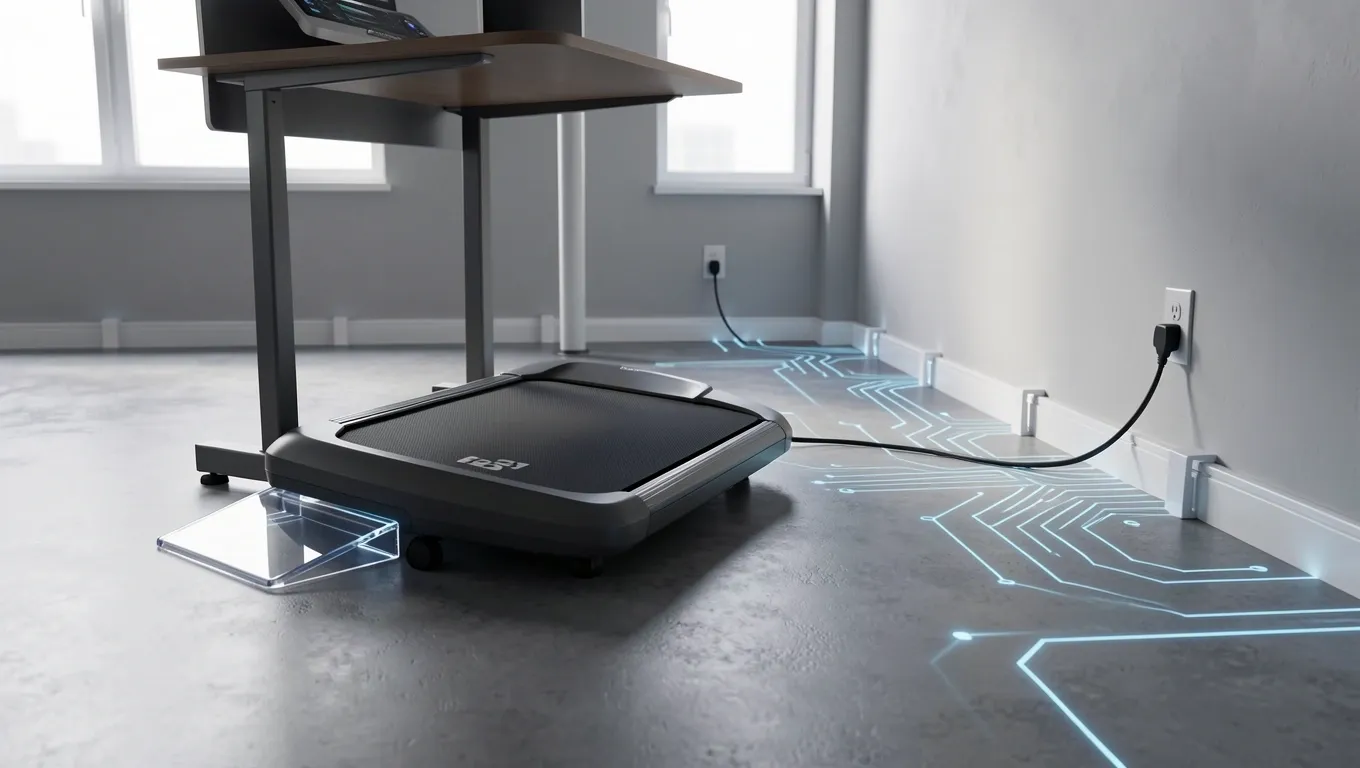
You set up your walking pad to move more during the workday. The last thing you need is to catch your foot on the power cable and take a hard fall.
That cable is the one weak point in an otherwise simple setup. I learned this the hard way when I first started walking at my desk.
The cord ran straight across the floor from the pad to the wall outlet. Every time I stepped off the pad, I had to look down and step over it. After one close call, I knew I had to fix it properly.
Learning how to properly route power cables to avoid tripping over your walking pad is not complicated.
It takes a few simple decisions about where the pad sits, how the cord travels, and what gear you use to cover it.
This guide walks through every method that works, so you can pick the one that fits your room.
Why Normal Cable Management Falls Short for Walking Pads
Regular computer cables can tuck behind a desk and stay out of sight. A walking pad is different.
The pad sits in an open walkway, and its motor needs a thick power cable that reaches back to a wall outlet. That cable has to cross the very space where you move your feet.
The cord also moves slightly when you walk on the pad, which can loosen weak tape or thin cable covers.
Most people try to hide the cable behind the desk leg or under a rug. That can work, but only if the cable is completely flat and the cover is strong enough to handle your weight.
Walking pads pull up to several amps depending on your speed and your body weight. A cable protector made for phone chargers will not survive a walking pad stepping on it all day.
Position Your Walking Pad With the Cable in Mind
Before you buy any cable management gear, look at where the pad sits in the room. The best setup avoids long cable runs across open floor.
If you can place the pad so the power cord side faces a wall outlet, you already solved half the problem.
Keep at least two feet of clearance on the sides of the pad. This gives you a safe zone for stepping on and off.
The power cable should leave the pad at the back or side and head straight toward the nearest outlet. Corners and angles force the cable to bend, which makes tripping more likely.
If you have a standing desk with a grommet hole, run the cord up through that hole and plug it into a power strip mounted under the desk.
This keeps the power connection close to the pad's control panel. Many walking pads have a detachable power cord, so you can swap it for a longer one if needed.
Always use the exact cord type the manual asks for.
Best Ways to Route the Power Cable Across the Floor
When the outlet is too far from the pad, the cable has to cross the floor. That is where most tripping accidents happen. Here are the methods that actually work, listed from simplest to most permanent.
Use a Floor Cable Protector
A floor cable protector is a rubber or PVC ramp with a channel cut into the bottom. You lay your cable inside the channel, close the lid, and step over the angled edges.
This is the same approach used in offices and warehouses to keep people safe.
For a walking pad, you need a protector that is wide enough and tall enough to handle a heavy power cord. Look for one with a channel at least 0.4 inches wide and 0.4 inches deep.
The outer edges should be sloped on both sides so your foot does not catch on the lip.
I tested a cheap one that stayed flat on the floor, but when I stepped on it with my full weight, the lid popped open. The cord came out and I nearly tripped again.
A sturdier model with a locking lid fixed that completely.
| Type | Best For | What to Watch Out For |
|---|---|---|
| Flat cord cover with adhesive | Low-traffic home areas | Peels up if you step on it often |
| Rubber cable ramp | Areas where you walk daily | Needs non-slip backing to stay put |
| Hard plastic floor protector | Heavy stepping, wheeled chairs | Make sure edges are beveled |
Run the Cable Along the Wall
If the pad sits sideways next to the wall, tape the cable to the baseboard using adhesive cable clips. This keeps the cord off the floor entirely.
The clip holds the cable flat against the wall, and you can add a small channel cover to hide it visually.
On carpet, wall clips work especially well because you can push the cable down into the carpet fibers near the edge of the room. The cord stays out of your walking path.
On hard floors, use clips that stick to the wall, not the floor. Wall-mounted clips stay in place better than floor tape when you vacuum or mop.
One thing to check: the cable should not pull tight from the pad to the wall clip. Leave a little slack near the pad so the motor can vibrate without yanking the cord out of the plug.
A loose loop near the pad is safer than a taught line.
Hide the Cable Under a Rug or Mat
Putting a walking pad on a rug is already common because it stops the pad from sliding. That same rug can hide the power cable. The key is to make sure the cable lays perfectly flat under the rug.
Any lump or bump becomes a trip point.
Use a thin, non-slip rug pad underneath the cable so the cord does not create a ridge on top of the rug. If your walking pad has its own mat, you can run the cable under that mat and out the side.
Just remember that the mat moves when you walk. You need to secure the mat with double-sided tape or a gripper pad underneath.
For carpets, do not just push the cable under the carpet edge. That can damage the cord over time, especially when the walking pad vibrates.
Instead, grind a small groove in the carpet underlay or use a carpet trim piece to protect the cord. This is more work, but it is the cleanest look and the safest result.
Use a Dedicated Cord Cover for Extension Cords
If your walking pad needs an extension cord, you have to follow stricter rules. The extension cord itself becomes a trip hazard too.
Use a heavy-duty extension cord rated for at least 15 amps and keep the total length short. Longer extension cords get warm and can cause a fire risk if the walking pad pulls high current.
Cover that extension cord with a cord cover designed for outdoor or indoor use. The cover should have a channel for the entire length. Some covers come in rolls that you cut to size.
That works well for a straight run from the wall to the pad. Avoid using multiple extension cords connected together. The connection point is where trips and electrical failures happen.
Extension Cord Rules You Should Follow
Walking pad manuals usually say to plug directly into a wall outlet. That is the safest option. If you cannot reach the wall, you have to use an extension cord. Follow these rules to stay safe.
- Use a cord rated for 15 amps or more. Look for a wire gauge of 14 AWG or lower.
- Choose the shortest length that reaches. A 6-foot cord is better than a 25-foot cord.
- Do not run the extension cord under carpet or through walls. It must be visible and easy to inspect.
- Check the connection to the walking pad. The plug should fit snugly, and there should be no exposed copper wiring.
- Never coil a long extension cord while in use. Coils trap heat and can melt the wire.
I tried using a power strip with a short cord and a longer extension cord connected to it. That setup failed when I walked faster on a higher incline. The connection at the power strip got warm.
I replaced both with one solid 12-gauge extension cord rated for heavy appliances, and the warmth disappeared. If your cord feels hot to the touch, stop using it and find a closer outlet.
What to Avoid When Setting Up the Cable
Some common shortcuts seem convenient but end up creating bigger problems.
Do not tape the cable to the floor with duct tape or painter's tape. The tape peels up over time, and then you have a sticky residue plus a loose cord.
Use actual cord clips or floor tape designed for carpets.
Do not let the cable hang from the walking pad with a loop that dangles over the walkway. That loop swings when you move and can catch your foot. Keep the cable tight to the floor or wall.
Do not put the power brick in a spot where you step. Walking pads typically have a large adapter block near the plug. That block is often taller than a cable protector.
Put a separate protector over the block or place it inside a small zip-tied bag under the desk.
Do not run the cable near a radiator or heating vent. The insulation on the power cord can soften, creating a shock hazard.
Frequently Asked Questions
Can I use a regular power strip with my walking pad?
Yes, if the power strip has a short cord and you plug it directly into a wall outlet. Make sure the strip is rated for at least 15 amps. Do not connect an extension cord to the power strip.
How thick of a cable protector do I need?
Look for a protector with a channel at least 0.4 inches wide and 0.4 inches deep. The outer ramp should be at least 1 inch wide on each side.
This size fits most walking pad power cords and feels smooth underfoot.
Is it safe to run the cable under my walking pad mat?
It is safe if the cable is completely flat and the mat is thin. Remove any air pockets. A thick mat can create a bump that causes the pad to wobble.
If you feel the cord through the mat, move it to the side.
What do I do if the outlet is on the opposite wall?
Use a cord cover that runs along the baseboard or wall, not straight across the floor. Or use a ceiling-mounted cable hoist with a retractable cord.
Any method that keeps the cable off the walking path is better than letting it lie across the open floor.
Routing your walking pad power cable properly takes about twenty minutes and removes a real danger from your daily routine. The simple rule is to keep the cable flat, covered, and out of the foot path.
Once you set it up, you can step on and off the pad without thinking about where the wire is. That peace of mind is worth the effort.