How to Prevent Tight Calves and Hips From Your Under-Desk Treadmill

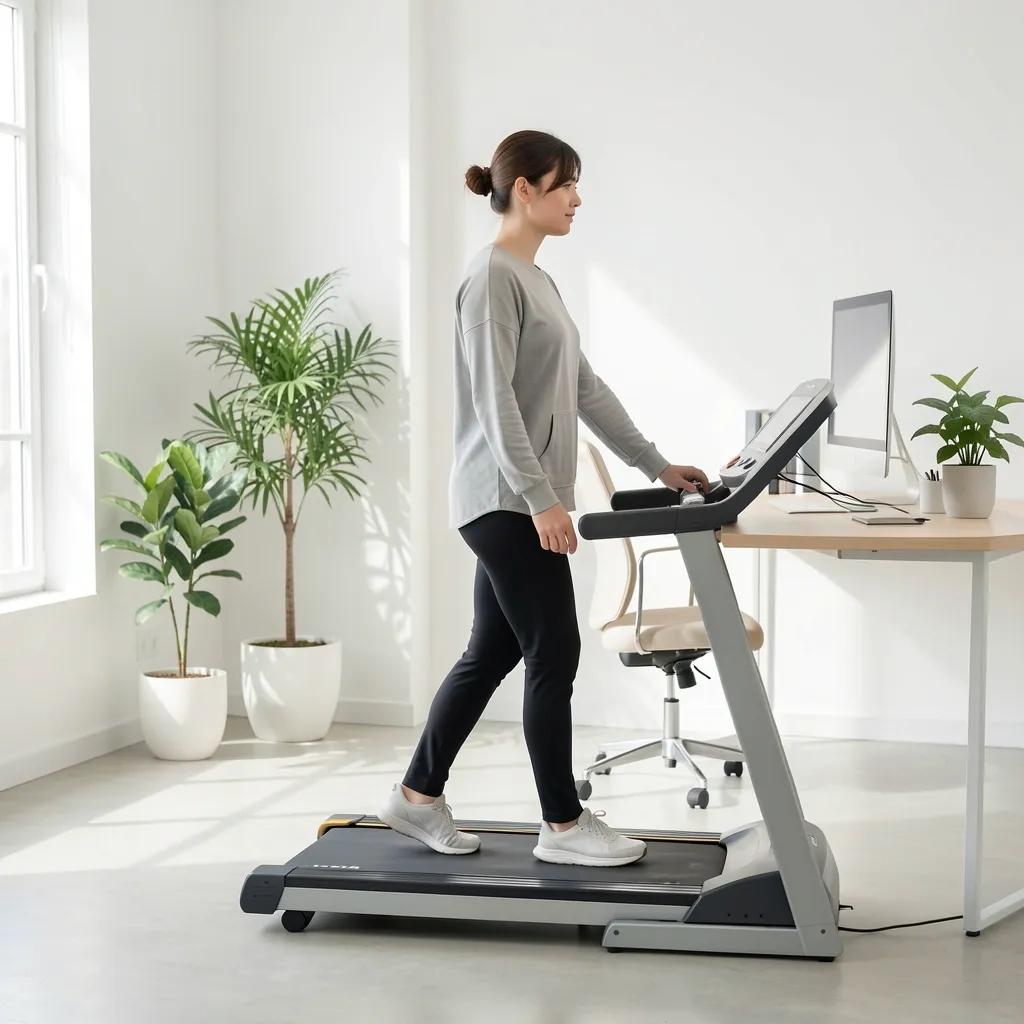
You bought the walking pad to feel better, not to trade one kind of ache for another.
If you're reading this, you already know the feeling: you step off the belt after a work session and your calves feel like someone wrapped them in duct tape. Your hips feel stiff, almost shorter.
Walking to the kitchen becomes a wading-through-sand ordeal.
Before any advice, let's get one thing straight. Tight calves and hips on an under-desk treadmill are not a sign of weakness, and they're not proof you wasted your money.
They're the predictable result of walking in a way your body never evolved to handle. The machine isn't the problem. The mechanics of walking while chained to a desk are.
So how do you prevent tight calves and hips after using an under desk treadmill? You fix the mechanics, not just the symptoms. Do that and the tightness fades, usually within a week or two.
That's the whole article in one sentence. The rest is how you get there.
Why Your Under-Desk Treadmill Tightens Your Calves and Hips
Most articles skip this part. They tell you to stretch and send you on your way.
But if you don't understand why the tightness happens, you'll keep stretching the wrong muscle at the wrong time and wonder why nothing changes.
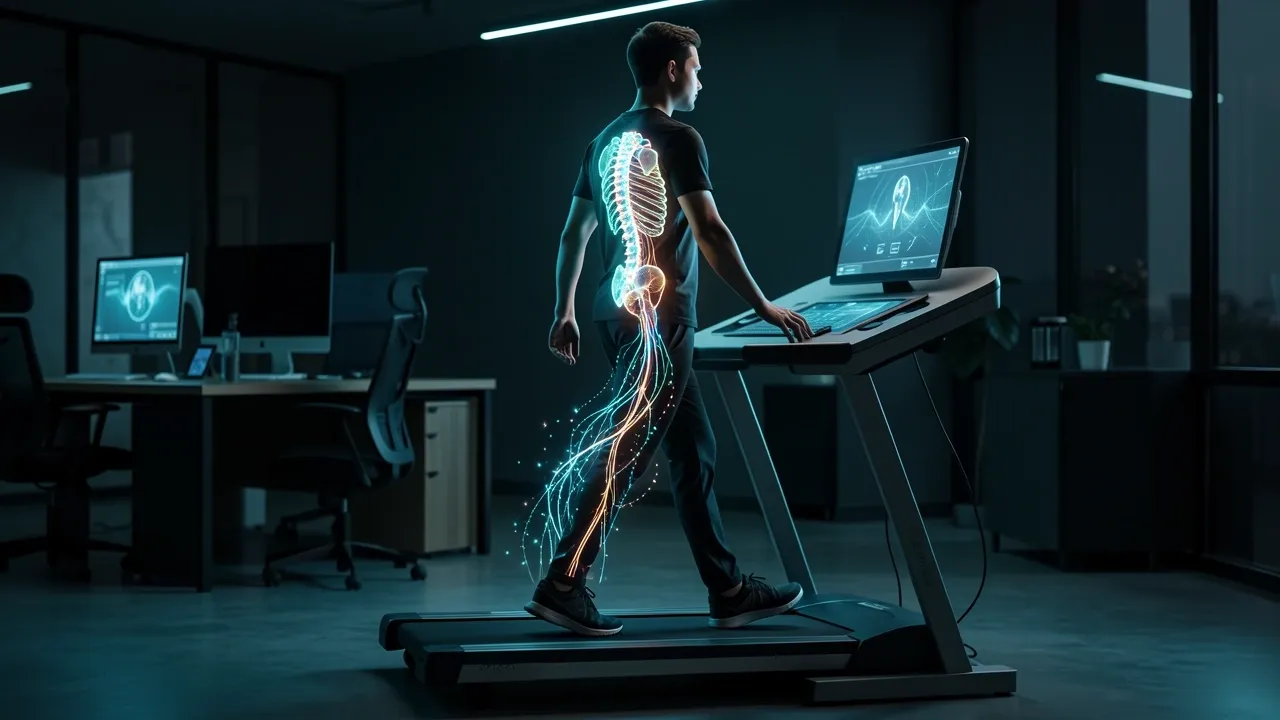
Normal walking is a full-body event. Your arms swing, your torso rotates, your hips extend behind you, and your calf muscles load and release through a long, generous range of motion.
Under-desk walking takes all of that away. I call it the desk gait, and it has three mechanical villains.
The Shortened Stride
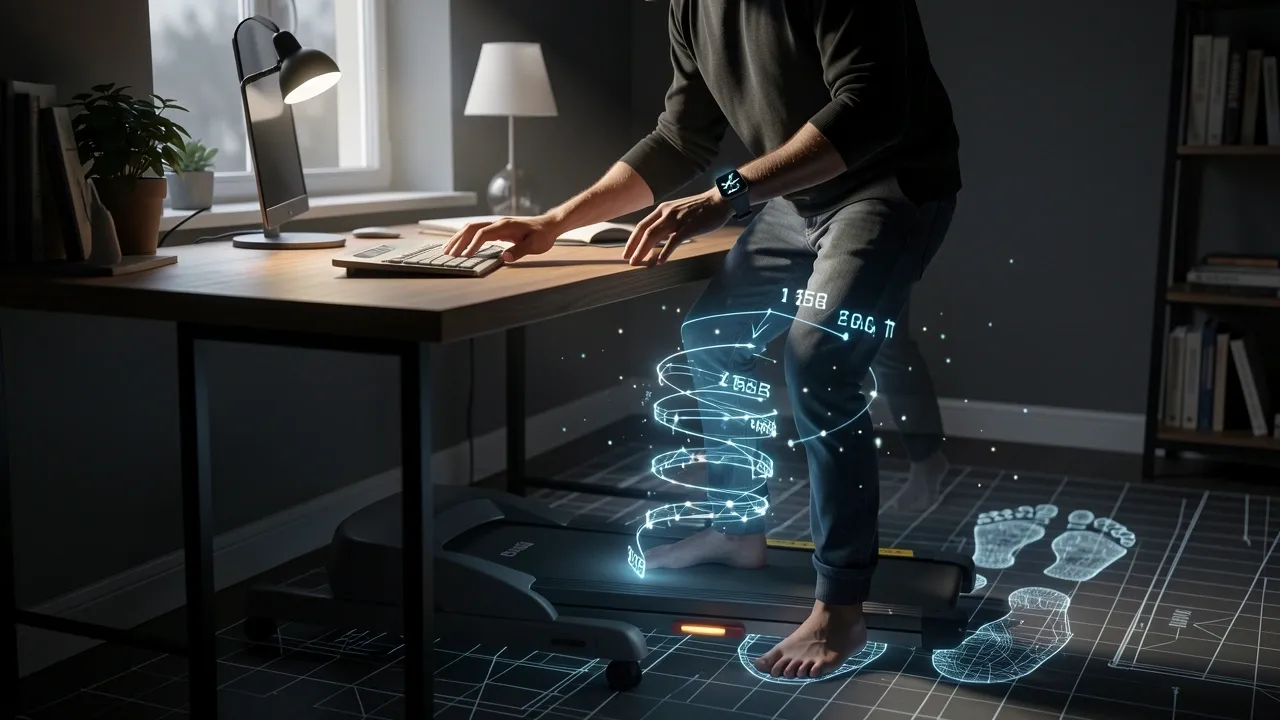
Under a desk, you cannot take a full step. Your shins bump the desk panel, your stride gets chopped, and you end up shuffling.
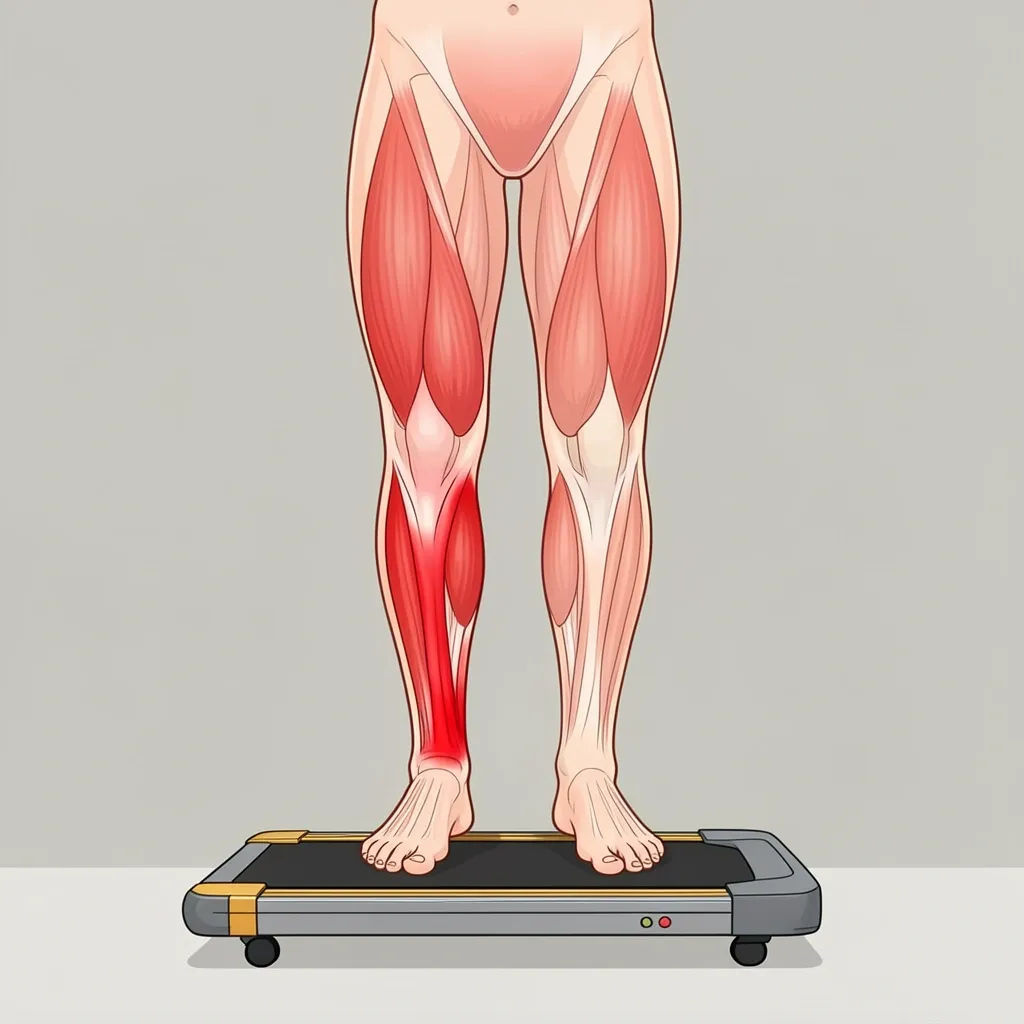
Your calves — the gastrocnemius and soleus, the two muscles on the back of your lower leg — are built to lengthen and spring through a full step.
In a shuffle, they work in a constant, abbreviated range with no recovery phase. Twenty minutes of that and they're buzzing. Sixty minutes and they're locked.
The Locked-Arm Posture
Your arms are the gyroscope your body uses to walk. Every time your right arm swings forward, your pelvis counter-rotates to keep you balanced.
Take the arm swing away — because you're typing, because your forearms rest on the desk — and those rotational forces have nowhere to go.
Your hips and the deep muscles around them absorb the load instead. That's why your hips feel like they've been through a wrestling match after a day of desk walking.
Sustained Hip Flexion
Your desk is in front of you, your screen demands your eyes, and your torso leans forward to meet it.
That lean keeps your psoas, the deep hip flexor that runs from your spine to your thigh, frozen in a shortened position for the whole session. Walking is supposed to be the thing that gives it a break.
On a desk treadmill, walking makes it worse.
One quick note before we move on: some tightness in your first two weeks is completely normal.
It's delayed onset muscle soreness — your muscles did work they weren't used to, and they're letting you know. But there's a difference between that healthy ache and a genuine strain.
Later in this article, the symptom key shows you exactly how to tell them apart. For now, know that the desk gait explains why you hurt, and it also explains how to stop hurting.
Desk walking is the equivalent of walking on a treadmill inside a telephone booth. You cannot stride, you cannot swing, you can only shuffle in place. Your body doesn't call that walking. It calls that a weird static squat with moving feet. Once you see it that way, the tight calves and hips stop being a mystery.
Audit Your Setup Before You Change Your Body
When I first set up my walking pad, I did everything wrong. I set the speed to 2.5 mph, kept my desk at sitting height, and wore my favorite zero-drop barefoot shoes.
By day three, my calves were so tight I could barely walk down the stairs. Here's what I learned the hard way, so you don't have to.
Speed: Slow Is the Secret
The single most common mistake is walking too fast.
Above roughly 2 mph, a desk-confined walker breaks into a shuffle — and a shuffle is a calf-killer because it turns your lower legs into shock absorbers with zero recovery time.
The golden rule: you should feel like you could hold a conversation while also standing completely still. For most people, that's 1.0 to 1.5 mph. It feels embarrassingly slow for the first two days.
That's fine. It's not cheating. It's biomechanically correct for the confined gait you're stuck with.
Desk Height and Monitor Position
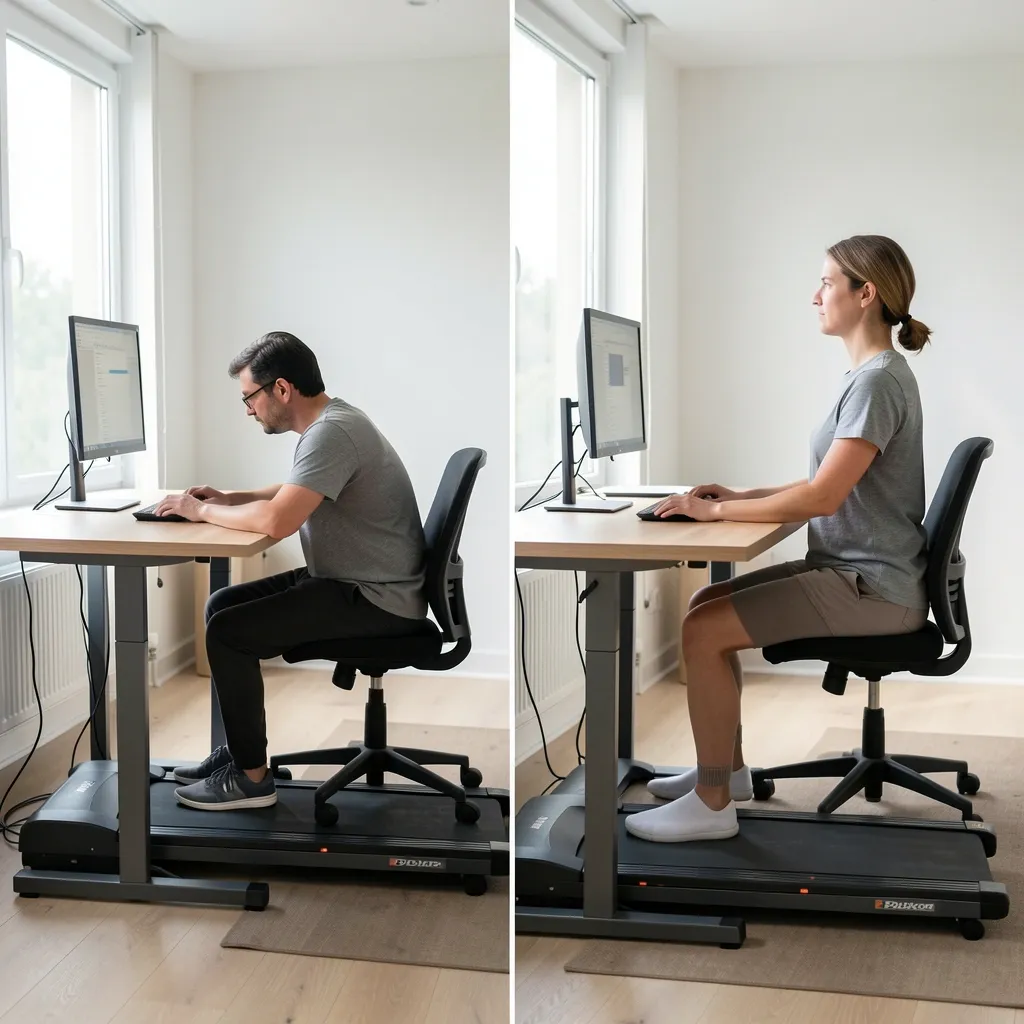
If your desk is too low, your shoulders round and your pelvis tilts forward, which deepens the hip flexion we just talked about.
If your monitor sits off to one side, your spine torques and one hip takes more load than the other all day. The correct stack looks like this: ears over shoulders, shoulders over ribs, ribs over hips.
As for the screen, it should sit at eye level while you hold that tall stack. Here's a 30-second self-check: stand tall, close your eyes, take two breaths, and open them.
The first thing you see should be the center of your screen. If you're looking down or sideways, raise or recenter it.
Footwear: The Zero-Drop Trap
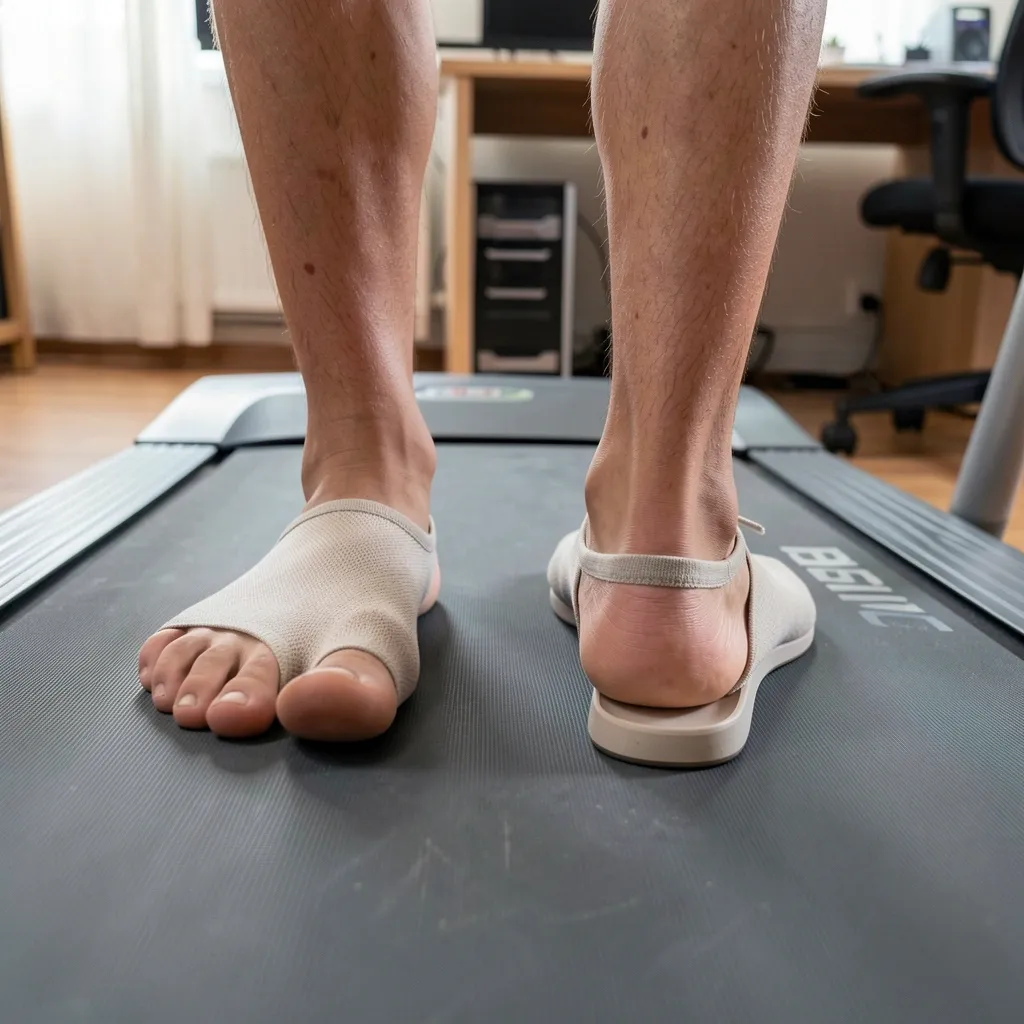
There's a well-meaning myth that barefoot-style shoes are best for treadmill desks because they "fix" your posture. For most people, they do the opposite.
If you've spent years in shoes with a raised heel, your Achilles tendon and calf muscles have adapted to a shortened position.
Slap on a zero-drop shoe and suddenly your calves are forced into a stretch they haven't seen in a decade — while also walking. That's a recipe for injury, not relief.
Start with a shoe that has a mild heel-to-toe drop of 4 to 6 mm. Your calves will thank you while they adapt.
How to Walk Without Feeding the Tightness
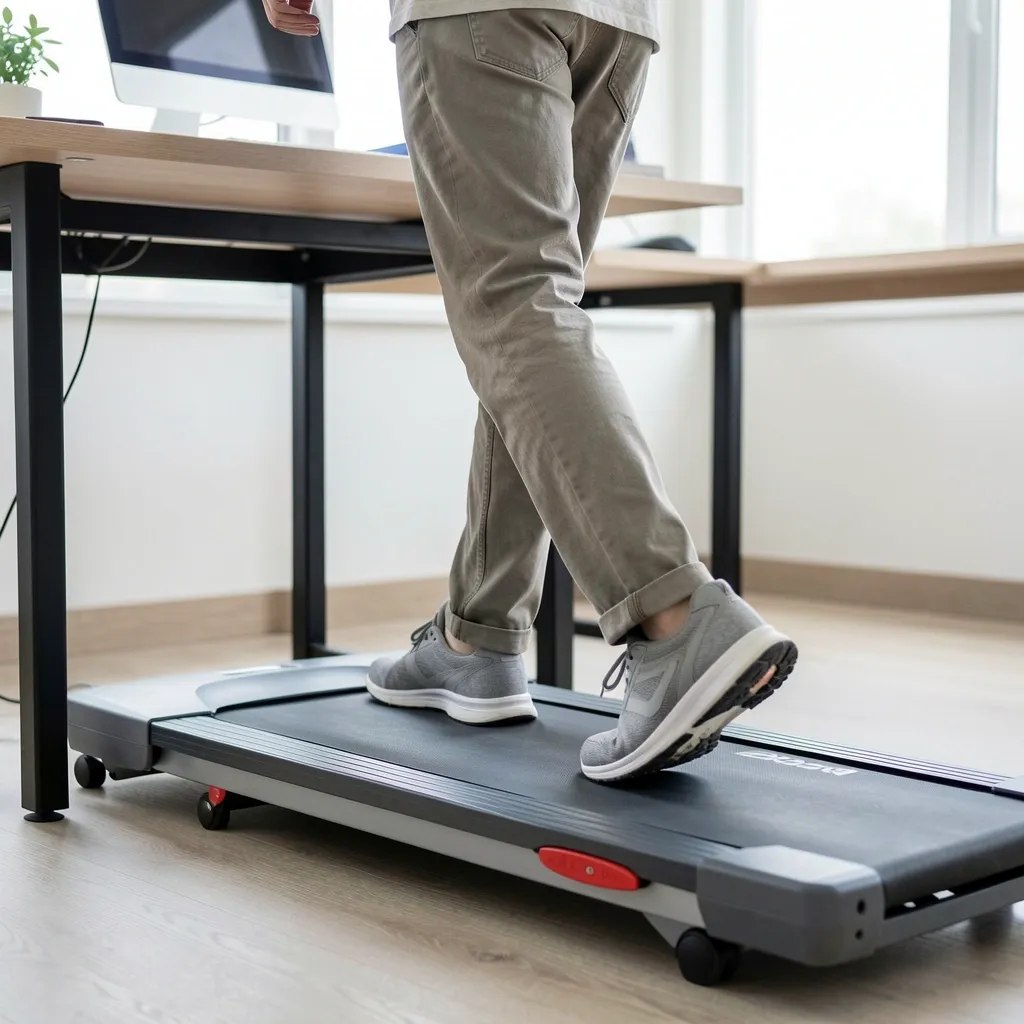
Once the environment is right, your job is to change one small thing at a time. These form cues are in order of importance — master the first before you worry about the fourth.
Land Midfoot, Not Heel-First
Slow treadmill walking encourages a heavy heel strike. Your foot slaps down in front of you, your calf works as a brake, and then you shuffle forward.
Instead, cue yourself to land on the ball of the foot, as if you're trying to step quietly on a creaky wooden floor at 2 a.m.
The midfoot strike keeps your calf in a more neutral range and shifts the work to your glutes instead of your lower legs.
Hold the Proud Pelvis
Walk like you're lightly tucking your tailbone toward an invisible chair behind you. That subtle tuck moves tension out of your hip flexors and into your glutes, where it belongs.
Most people feel the difference immediately — their hips loosen within a single session. If you forget everything else from this section, remember this cue.
Raise Your Cadence, Not Your Speed
If something feels tight, don't slow the belt down further — take faster, shorter steps instead.
Think of a waiter weaving through a packed kitchen: quick, small, precise steps, no long gliding strides.
A higher step rate at the same speed keeps your calves fresher and removes the shock absorber effect of long, slow strides.
The Arm Trick Your Pelvis Will Love
You can't do a full arm swing while you type. But you can let your elbows brush your ribs rhythmically, like you're marching in place, even at a reduced range.
This tiny pendulum motion gives your pelvis a little of the counter-rotation it's starving for.
On days when I'm on a call and don't need my hands, I let my arms swing fully — and the hip relief is immediate. When I'm typing, the elbow-brush version is enough to keep the tension from building up.
No, you don't need 10,000 steps. Volume is irrelevant when gait quality is poor. Three thousand honest steps with good form under your desk beat eight thousand sloppy ones every time.
The Step-Off Ritual — Do This Within Two Minutes of Stopping
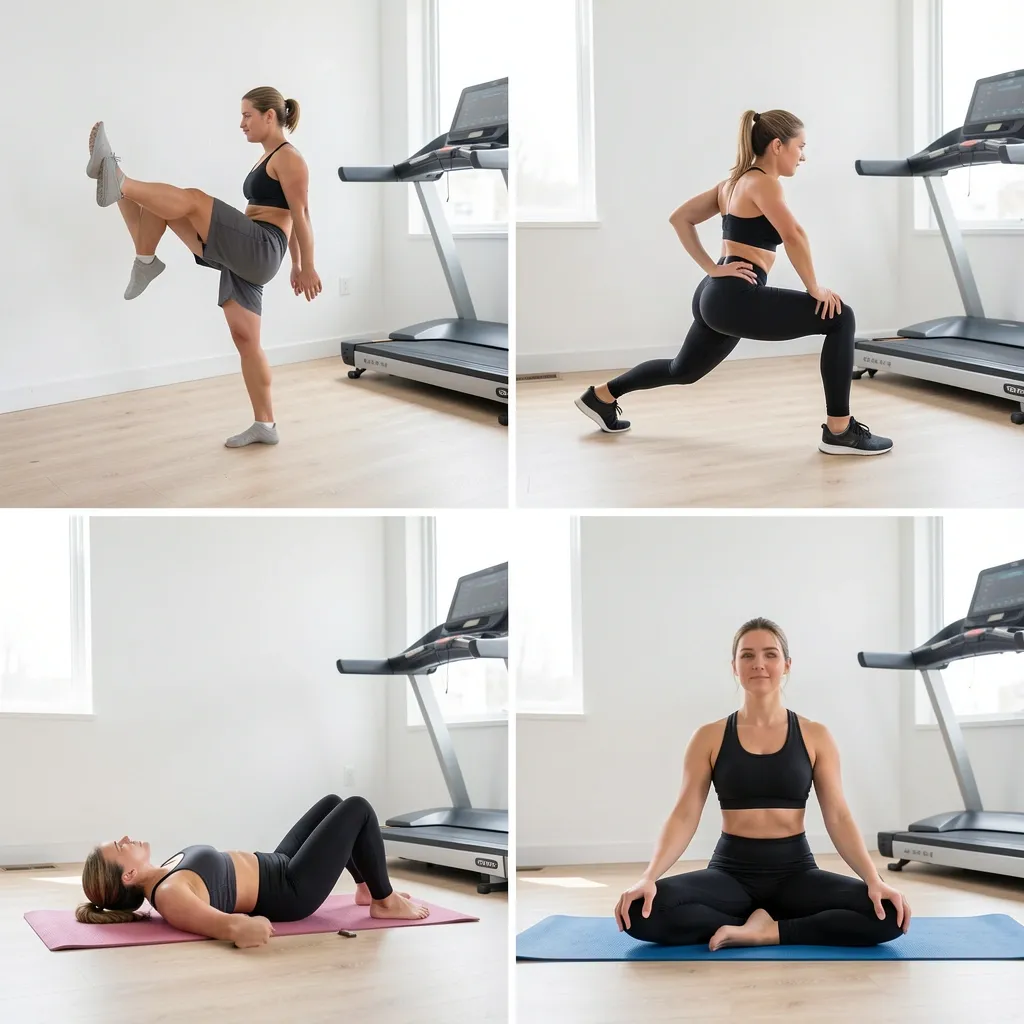
Here's where most of the internet fails you. It tells you to stretch at night, or in the morning, or whenever you remember. But the timing of the stretch is the whole game.
Here's why it matters: while you walk, the muscles of your calves and hips stay shortened for the entire session.
When you step off, they're still in that shortened state — and they're at their most pliable right then.
Stretching within two minutes of stepping off has roughly ten times the effect of stretching six hours later.
In my first week with a walking pad, I'd step off, check email for twenty minutes, then stretch. My calves still ached.
Once I moved the stretch to immediately after stopping, the ache faded by day four. That's not a coincidence. That's muscle physiology working in your favor.
Do this exact sequence. It takes about eight minutes total.
- Calf pump (30 seconds). Stand, shift your weight onto the ball of one foot, and press the heel down until you feel the back of your lower leg lengthen. Hold for two breaths, release, and switch sides. This reintroduces the full range of motion the desk gait suppressed.
- Deep hip flexor lunge (60 seconds per side). Drop into a half-kneeling lunge, then tuck your tailbone under — the same proud pelvis reverse — so you feel the stretch in the front of your hip, not the back of your leg. This targets the psoas that was frozen in a shortened position. Don't rush it.
- Standing glute bridge or wall sit to stand (45 seconds). If you have a wall nearby, slide down into a sit, push through your heels to stand, and repeat slowly ten times. This re-establishes hip extension, the direct opposite of the flexed desk posture you've been holding.
- Pigeon stretch (90 seconds per side). From a tabletop position, bring one knee toward the outside of your same-side wrist and slide the opposite leg back. This is for your piriformis, the muscle that takes over the rotational load when your arm swing is missing. It will feel tight. That's the point.
- The calf-sink walk (60 seconds). End by walking normally, full stride, across your room or down the hall — no desk, no belt. This reminds your nervous system what an actual gait feels like. Most people feel their calves reset within ten steps.
Do this after every session, not just on the days you feel tight. It's the difference between a body that recovers and a body that accumulates tension.
How to Build Your Walking Tolerance Without Breaking Down
Once your setup is fixed, your form is honest, and the step-off ritual is a habit, the last piece is patience.
The biggest mistake people make is going from zero to 45 minutes a day because the first two sessions felt fine.
The tightness doesn't catch up until day four, and by then you've set yourself back a week.
The 4-Week Protocol
Follow this progression and your body gets the time it needs to adapt the exact muscles the desk gait demands.
- Week 1: 10 to 15 minutes per session, max two sessions per day. Take a rest day between walking days. Yes, really.
- Week 2: 20 to 25 minutes per session. Two sessions per day are fine now, but not on consecutive days.
- Week 3: 30 to 35 minutes per session. At this point you can usually walk every weekday.
- Week 4 and beyond: Up to 45 to 60 minutes per session — but only if you have no lingering tightness beyond 30 minutes after stepping off. The moment you do, drop back a week.
That last line is the whole protocol in miniature: the desk gait will always challenge you, but the challenge only stops being painful if you let your body adapt slowly.
The 60-Second Symptom Key
Not all tightness is the same. Use this table to tell the difference between "this is fine, keep going" and "this is a red flag, stop now."
| What you feel | What it means | What to do |
|---|---|---|
| General thickness in the calf that eases after a few steps | Normal adaptation. Your muscles are adjusting to new work. | Keep going. Stick to the weekly protocol. |
| Pinch or burning on the inside of your shin, near the bone | Overpronation under load. Your foot is rolling inward and your shin is working overtime. | Shorten the session by half, recheck your shoe choice, and slow the belt by 0.3 mph. |
| Deep heat in the front of the hip that lasts over an hour | Your desk posture is the real culprit, not the walking. | Stand up and walk away from the desk for two minutes every 20 minutes. Re-audit your monitor height. |
| Morning heel pain, right where the plantar fascia connects | You're overstriding. Your foot is landing too far ahead of your body. | Drop the belt below 1.5 mph and shorten your steps until the gait resets. |
The stop-go check. Answer these three questions honestly. Do I have sharp pain, or just dull tightness? Does the tightness fade within 30 minutes of stepping off?
Did I do the step-off ritual, or did I skip it and go straight back to my chair? If the answer to the first is "sharp," stop and see a physiotherapist.
If the second is "fades," you're fine — keep going. If you skipped the ritual, that alone explains why today feels worse than yesterday.
If your form is honest, your setup is right, and you've given the protocol two full weeks, the tightness fades to near zero. If it doesn't, see a physiotherapist.
But here's what I've seen in my own body and in friends I've helped set up with walking pads: it almost always does.
Frequently Asked Questions
Is walking backward on an under-desk treadmill a good way to loosen tight hips?
Yes, and it's underrated. Reverse walking recruits knee extension and hip extension, both of which are underloaded in forward desk gait. But treat it as a supplementary drill, not a replacement.
Start with three to five minutes per session, at a slower speed of 0.8 to 1.0 mph, and do it before your forward-walk block, not after.
Your nervous system benefits from the novelty, and your hips get a range of motion they won't get any other way under that desk.
Is it normal for my shins to hurt before my calves do?
Surprisingly common, especially in week one.
Desk walking produces a staccato, high-cadence gait where the front of your shin — the anterior tibialis — has to fire on every single step to lift your foot.
It's doing work your calves aren't doing yet, which is why it complains first.
Shorten your stride length, slow the belt by a few tenths of a mile per hour, and the shin burn usually settles within a week. If it persists, get it checked, because it can also signal overpronation.
I have naturally tight hip flexors from running. Am I more at risk?
Yes. If your psoas is already shortened from running, the desk gait aggressively exploits that imbalance.
Your prescription is more conservative than someone with neutral hips: start at the absolute minimum of 10 minutes per session, and treat the step-off ritual as more important than the walking itself.
The stretch is where you make progress. The walking is just the load.
Will a taller desk actually change the pressure on my calves?
Indirectly, and yes.
A desk that's too low folds you into hip flexion, and when your hips are folded, your ankle mobility has to compensate — which pulls your calves into work they're not designed to do.
Raising the desk until you can hold a tall, stacked posture gives your calves room to use their full range of motion.
The desk never touches your lower legs, but it absolutely changes how hard they have to work.
What if I follow all of this and still get calf cramps at night?
Nighttime cramping is usually not the tightness from the treadmill. It's a separate animal.
Common culprits are dehydration and low electrolytes — magnesium and sodium — or the fact that you sat in a chair for six hours after walking, leaving your calves in a shortened position all evening.
Drink more water, take a gentle 10-minute walk after dinner without the desk, full stride and free gait, and if the cramps persist, consider a calf compression sleeve at night.