How to Manage Shin Splints on a Treadmill Desk Without Losing Momentum

You finally set up the treadmill desk. You were excited about the steps, the focus, the metabolic boost.
Maybe you wanted to break free from eight hours of sitting, or reclaim some movement after years at a desk. Then, three hours into your second day, a dull burn creeps up the front of your lower leg.
By day four, every step on that belt reminds you of the pain. You start wondering if the whole experiment was a mistake and whether you should just go back to a static chair.
It was not a mistake. If you are starting a treadmill desk routine and your shins are already protesting, you are in the right place.
Shin splints are not a sign that walking while working is impossible. They are a sign that your lower legs were asked to handle more than they were ready for, with no ramp-up period.
Your muscles were deconditioned from years of sitting, and suddenly they needed to support your body weight for hours at a time. The fix is not quitting.
The fix is re-engineering how you load your legs.
This article comes from direct experience. I spent months adjusting my own setup after hitting the exact same wall, and I have since coached colleagues through their own flare-ups.
What follows is a clear, practical plan in three parts: adjust your walking parameters, fix your workstation ergonomics, and add targeted strengthening work.
If you follow it, you can keep working at your desk while your shins recover and adapt.
First, you will understand why a slow walk can hurt more than a run.
Then you will learn how to rule out a more serious injury, adjust your setup today, manage your walking time, strengthen the right muscles, and return safely if you have already been forced to stop.
Here is the honest truth. You will get better. You do not need to abandon your treadmill desk. You need to walk smarter, and this guide will show you exactly how.
Why a Treadmill Desk Creates Shin Pain When Running Never Did
Here is the first thing that confuses most desk walkers. You could jog a few miles without issue, but a slow walk at your desk destroys your shins. How does that make sense?
The answer is cumulative load. A thirty-minute run gives you roughly 3,000 to 4,000 steps with plenty of rest afterward.
A four-hour treadmill desk session can deliver 8,000 to 12,000 steps, with no meaningful recovery between them.
Each individual step is low impact, but your lower legs do not care about individual steps. They care about total strain over hours.
I call this the staircase problem when I explain it to my team. Running is like sprinting up one flight of stairs. A treadmill desk is like slowly climbing forty floors across an entire day.
Both can be tiring, but the slow climb leaves your legs doing the same motion over and over without a break. That is the fatigue-load mechanism that standard running advice never addresses.
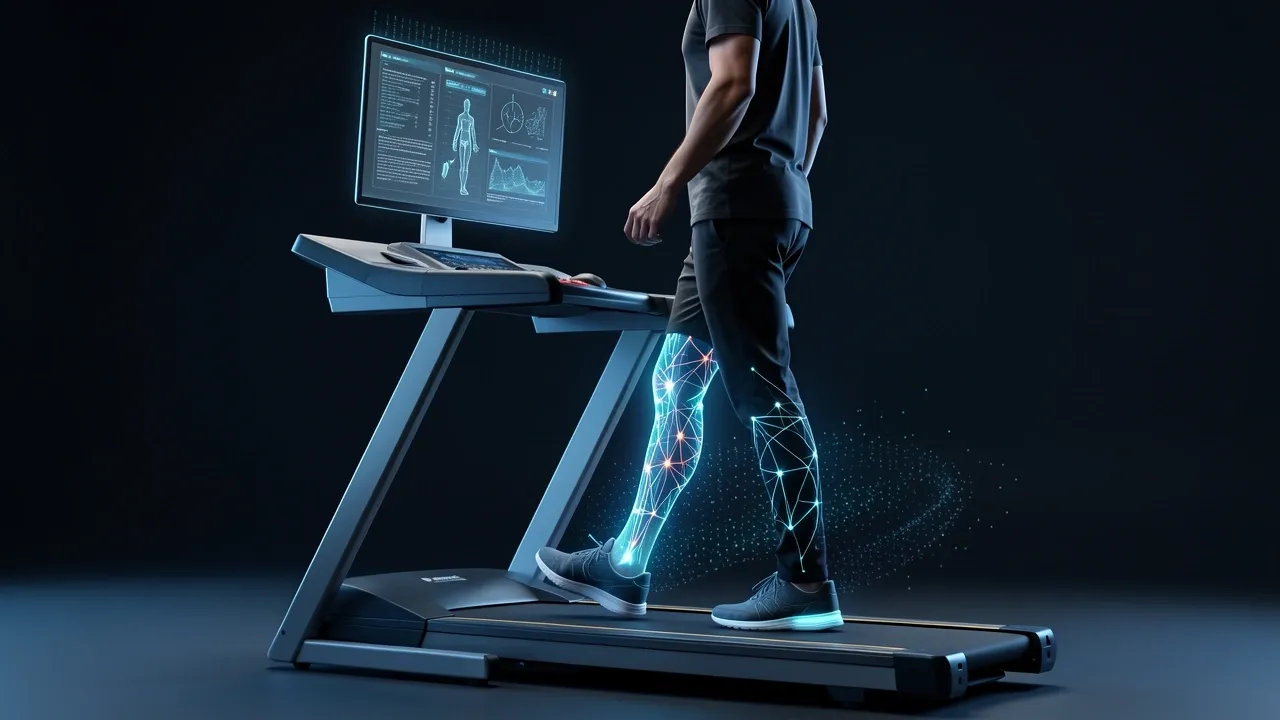
The muscle paying the price is the tibialis anterior, which runs along the front of your shin.
Every time your foot lands, this muscle works to lower your toes smoothly from heel strike to full contact. On a treadmill belt, your foot lands slightly differently than on solid ground.
The belt pulls your foot back as it strikes, forcing the tibialis anterior to work a little harder on every rep. Walk slowly and the loading phase lasts longer per step.
More time under tension, repeated thousands of times, adds up to fatigue and inflammation.
Then there is your posture. You are not just walking. You are walking while typing, reading a screen, and probably slouching forward. A slouched upper body shifts your center of mass forward.
Your hips tighten, which shortens your stride, and a shortened stride turns into a shuffle. A shuffle increases the force your lower legs absorb and keeps your tibialis anterior in a strained position.
This is why the first hour feels fine and the third hour burns. The muscle is not weak in the sense that it cannot contract. It is endurance-deconditioned.
It runs out of capacity long before your cardiovascular system does.
Is It Shin Splints or a Starting Stress Fracture? The Desk Walker's Reality Check
Before anything else, you need to know what you are dealing with. Shin splints, medically called medial tibial stress syndrome, are an inflammation of the muscle attachments along the shin bone.
They are painful, but they are not dangerous if you manage them correctly. A stress fracture is a small crack in the bone. Walking on it can turn a small crack into a serious break.
Here is the important difference.
| Symptom | Shin Splints | Stress Fracture |
|---|---|---|
| Pain location | Spreads over a few inches along the inner shin | Pinpoint spot on the bone |
| Pain during a walk | Worse at the start, often eases mid-session | Gets worse the longer you walk |
| Pain at rest | Usually none once you stop moving | Can ache even with no weight on it, sometimes at night |
| Tenderness to touch | Sore over the muscle, not the bone itself | The bone itself feels tender when you press on it |
Try two quick self-tests at home. First, the pinch test. Run your fingers along your shin bone from the knee to the ankle. If one specific spot feels sore to the touch, that is a red flag.
Second, the hop test. Hop on the affected leg five times. A sharp pain on landing is a strong warning sign.
If you feel any of these red flags, stop all treadmill walking and get imaging. Do not try to walk through a stress fracture.
Swelling, bruising, warmth over the shin, or a history of a prior stress fracture also means you need a doctor, not a blog post.
The Three Immediate Adjustments That Stop the Ache
Let us assume you have shin splints, not a fracture, and you want to keep working. These changes will reduce your shin pain before your next walking block. No strength training required, just setup.
Adjustment 1: Slow to a Conversation Pace
Most people set their treadmill desk to a speed that feels like exercise. For many, that means 2.5 to 3.5 miles per hour. That is a mistake.
The goal of a treadmill desk is to keep your body moving while your brain works. It is not a cardio session.
Set your speed to 1.2 to 1.8 miles per hour. A simple test: if you cannot easily speak a full sentence aloud, you are walking too fast.
At lower speeds, your foot strike is lighter, your stride is more controlled, and your tibialis anterior gets a much shorter loading phase on each step.
Adjustment 2: Level the Incline and Shorten Your Stride
It sounds logical to walk uphill to protect your shins, but a steep incline shifts the load into your calves, your Achilles tendon, and the posterior tibialis tendon on the inside of your ankle.
That is a different flavor of shin pain, and it is just as annoying. Start at zero incline. If you feel ready for a challenge after a few weeks, raise it to half a percent, maybe one percent.
Never go higher.
Also, shorten your stride intentionally. Take quicker, smaller steps than you would outdoors. Try to land quietly, with a midfoot or forefoot contact rather than a heavy heel thump.
I call this the sneaky-step trick. If you can walk without making noise on the belt, you are loading your shins far less.
The Quick Posture Fix That Changes Your Stride
Before you think about footwear, look at how you stand while you type. Your monitor should sit at eye level, about an arm's length away. Your shoulders should be relaxed, not rounded forward.
The desk surface should hit at elbow height so your arms rest comfortably without forcing your torso to lean.
The worst offender is a desk that forces you to reach forward to type. This leans your upper body toward the screen, tucks your pelvis, and shortens your stride into a shuffle.
If you catch this pattern, move your keyboard closer, raise your monitor, and check that your elbows sit at roughly ninety degrees. Small changes here take serious pressure off your shins.
Adjustment 3: Change Footwear and Flooring Together
Your shoes matter as much as your speed. Cushioned running shoes are not automatically right for a treadmill desk. You want a low-drop shoe with a flexible sole that lets your foot move naturally.
Avoid stiff motion-control shoes, which restrict your gait and force the shin muscle to work harder. A four to six millimeter drop is a good range for most people.
Do not walk barefoot or in socks. The belt friction heats your feet, and you lose all cushioning, sending impact straight up your shins. Add a firm foam mat under the treadmill. Not a squishy yoga mat.
You want a dense mat that absorbs vibration without letting your feet sink. The right shoe paired with the right mat can cut your shin discomfort noticeably on day one.
The Time-on-Feet Protocol — Load Management for People Who Need to Work
Speed adjustments help, but the real secret to treadmill desk success is duration management. Your body needs time to build tolerance, and you can build it without losing work hours.
Here is the protocol that has worked best for me and everyone I have guided through this process.
The 25/35 Pattern
Start with 25 minutes of walking, then 35 minutes of sitting. Alternate these through your workday. In the first week, do no more than three walking blocks per day.
That gives you a total of 75 minutes of walking, spread across the day, with solid recovery breaks.
This pattern is forgiving and lets your legs adapt without a single long session pushing them too far.
The 10 Percent Weekly Rule
Increase your total daily walking time by no more than 10 percent each week. If you walked 75 minutes per day in week one, add at most seven or eight minutes per day in week two.
This feels painfully slow, and that is exactly the point. The tissues in your lower leg remodel and strengthen based on gradual progressive load. Skip the ramp and you will be back to day one pain.
The 24-Hour Response Check
Pain is a lagging indicator. If your shins hurt the next morning, yesterday was too much. Your body needs about 24 hours to show inflammation from overuse.
If you wake up sore, cut your total walking time by 25 percent for the next two days. This one rule prevents the pattern where you feel fine, push too hard, and pay for it in the middle of the night.
The Built-In Break
Do not aim for continuous walking, even after you adapt. Take a five-minute sitting break every 45 to 60 minutes. This permanent micro-break lets the lower leg muscles unload and restores blood flow.
It is the single biggest difference between someone who walks at their desk for years and someone who quits after a month.
You can also use a simple self-regulation system based on pain level during a walk. I call it the color zone system.
| Zone | Pain Level | Action |
|---|---|---|
| Green | 0 to 3 out of 10 | Walk as planned and continue your normal progression |
| Yellow | 4 to 6 out of 10 | Cut walking time by 30 percent today and add one extra seated break |
| Red | 7 or higher, or pain climbing during the session | Stop the treadmill for the day and treat it as a flare-up |
This gives you a decision-making tool instead of guessing whether you can push through.
The Desk-Specific Strength Protocol to Eliminate Future Flare-Ups
Adjusting speed and duration will stop the acute pain. Strength work is what stops it from coming back. Most generic shin splint routines focus on runners.
The desk worker needs a different set of exercises because the underlying problem is different: deconditioned muscles from too much sitting suddenly asked to handle hours of walking.
Tibialis Anterior Band Dorsiflexion
This is the single most important exercise for treadmill desk shin pain. Sit at your desk, anchor a light resistance band under a table leg, and loop the other end over the top of your foot.
Pull your toes up toward your shin against the band, then lower slowly. Do 3 sets of 20 reps on each side, twice a day. You can do this while reading emails or sitting in a meeting.
It directly strengthens the muscle that fails during walking.
Eccentric Calf Drop
Stand on the edge of a stair step with your heels hanging off. Rise up on both toes, lift one foot, and lower the other heel slowly below the edge over three seconds.
Hold for three seconds at the bottom, then step back up using both feet. Do 3 sets of 10 reps on each leg, every other day.
This builds the calf muscles' ability to absorb repeated loading and takes pressure off the front of your shin.
Towel Scrunches
Sitting in a chair, place a towel flat on the floor under your foot. Scrunch the towel toward you using only your toes, then push it back out.
Alternate feet, or place a light book on the far end of the towel for resistance. Do 2 sets of 30 seconds per foot.
Weak foot muscles force the shin muscles to take over, so strengthening your arch and toes pays off quickly.
Glute Bridge with Pause
Your glutes control your pelvis as you walk. Weak glutes let your hips drop and add rotational stress to the shin bone. Lie on your back with knees bent and feet flat on the floor.
Drive through your heels to lift your hips, hold for two seconds at the top, then lower. Do 3 sets of 15 reps daily.
This exercise is boring, but it fixes a root cause that almost no desk walker considers.
Nightly Calf Massage
After you step off the treadmill, spend five minutes rolling your calves with a foam roller. Target the gastrocnemius and soleus muscles along the back of your lower leg.
Do not roll directly on your shin bone. Massage the muscle, not the bone.
Tight calves pull on the connective tissue that wraps around the shin, so loosening them gives the whole lower leg more room to move.
The Re-Entry Sequence — Coming Back After a Flare-Up
If your shins are already very sore, or if a previous flare-up forced you to stop, do not jump straight into the 25/35 pattern. You need a dedicated return sequence. Here is exactly how to come back.
Day 0 to 2: Full Rest
Stop the treadmill completely for at least two days. Work at a normal sitting desk, or a standing desk with no walking. Ice the shin for 10 minutes at a time, two to three times daily.
Do gentle ankle circles throughout the day. This rest period is non-negotiable. Acute inflammation needs about 48 hours to calm down before any loaded walking is safe.
The Green Light Gate
Before you return, test yourself. You must be pain-free when walking to the bathroom, pain-free when climbing one flight of stairs normally, and pain-free when pressing on the shin.
If any of these cause discomfort, wait five more days and retest.
Week of Return: The 15-Minute Debut
Walk no more than 15 minutes total, at a speed of 1.0 to 1.2 miles per hour, zero incline. Split it into three five-minute blocks if needed. If symptoms reappear at any point, you are not ready.
Wait five more days and try again.
Week Two: The 25/45 Pattern
Once the 15-minute day feels easy, move to the 25/45 pattern from the load management section. For this first week, keep it to two blocks maximum per day so your total stays under an hour.
Week Three: The 10 Percent Escalation
Now you can resume the normal progression from the previous section. Add 10 percent of your total daily time each week. Here is a critical rule: never increase speed and time in the same week.
Change one variable at a time. If you add twenty minutes to your day, keep the speed exactly the same. If you raise the speed, hold the time steady.
The Two-Day Rule
After a flare-up that sent you back to zero, you must complete two consecutive pain-free days at your target level before escalating again.
This guards against the common mistake of feeling better for one afternoon and immediately overdoing it.
Myth-Busting Treadmill Desk Shin Splints
There is a lot of bad advice floating around about shin pain and walking. Here are the myths that actively hurt desk walkers.
Myth 1: Walking slowly cannot hurt you
Duration matters more than speed. Four hours at a low speed creates more strain cycles than twenty minutes at a high speed. Slow walking is not harmless. It is just a different type of load.
Myth 2: Push through the pain to build resilience
If you walk into 7 out of 10 pain, you are deepening the inflammatory cycle. The tissue is already overloaded. Pushing makes it worse. Load management builds resilience far more effectively than grit.
Myth 3: A high incline takes pressure off your shins
A steep incline shifts stress to the calf and Achilles tendon, which shows up as posterior shin pain instead of anterior. You traded one problem for another.
Myth 4: Once you are pain-free, you can return to a full eight-hour day
Pain-free does not mean fully adapted. Your connective tissue is still remodeling for roughly six to eight weeks after symptoms disappear. The 10 percent rule exists for a reason.
Skipping it is how flare-ups become chronic.
Myth 5: A treadmill desk is just like walking to the bus stop
A bus stop walk has natural rest, varied gait, and changes in direction. A treadmill forces the exact same muscles to fire in the exact same pattern for hours at a time.
That artificial repetition is what makes it harder on your shins than walking outdoors.
Frequently Asked Questions
If my doctor confirms a stress fracture, can I return to the treadmill desk immediately after the pain stops?
No. A stress fracture requires six to eight weeks of healing and a graded return with medical clearance. Jumping back on the belt the first day you feel fine is the classic path to a complete break.
Follow your doctor's plan, then use the re-entry sequence above.
Should I use zero-drop shoes or a four-millimeter-drop shoe under my desk?
A four to six millimeter drop with moderate cushioning is the safest starting point.
Zero-drop shoes stress your calves through a full range of motion, which is exactly what your calves cannot handle when they are already strained.
Move to zero-drop only after your calves tolerate full-range loading without pain.
Is a walking pad more likely to cause shin splints than a full treadmill?
They carry the same mechanical risk, but walking pads have shorter belts, which naturally forces a shorter stride. That can actually help.
The downside is that most lack incline adjustment, so you lose a progressive loading tool as your body adapts.
What is the maximum safe daily walking duration for a treadmill desk?
For most people, four to five hours is a healthy ceiling. Beyond that, you spend so long on your feet that joint and tendon load overtakes your body's ability to recover.
Even with perfect form, the risk of a new overuse injury climbs sharply.
Do compression socks help during the walking session or only after?
Low to moderate compression socks, around 15 to 20 mmHg, worn during the session can reduce muscle vibration and improve blood flow, which lowers the perceived strain on the front of your shin.
They are a supportive tool, not a cure. You still need the strength protocol to fix the root cause.