How to Apply Walking Pad Lubricant: A Complete Guide

If you own a walking pad, you know that a little oil now and then keeps it running quiet and smooth. But the actual procedure is less straightforward than most guides make it sound.
You lift the belt, apply 5 to 10 ml of silicone oil in an S-pattern, then run the belt at low speed for a few minutes. That part is simple.
What most advice leaves out is how to handle a walking pad with almost no gap under the belt, what to do if this is your first lubrication on a brand new machine, and how to tell if the oil actually spread where it needs to go.
This guide covers all three, so you never have to guess or click away to another page.
What You Need Before You Start
The only lubricant you should use is 100% silicone treadmill oil. Nothing else. Household oils, WD-40, or any petroleum-based product will damage the belt rubber and the deck surface over time.
Buy a bottle that clearly says "100% silicone" on the label.
Some bottles come with a precision nozzle, but for many compact walking pads you will need a syringe with a flexible tube or a small squeeze bottle with a thin tip. Other tools you might need:
- A lint-free cloth or paper towel
- Isopropyl alcohol (70% or higher) for cleaning the deck
- A ruler or tape measure to check belt clearance
How to Tell If Your Walking Pad Needs Lubrication
Do not guess by calendar alone. Use the touch test. Unplug the machine, lift one side of the belt, and slide your hand across the deck. If the deck feels dry, rough, or powdery, it needs oil.
If you feel a slightly slick or waxy layer, the existing lubricant is still working.
Other signs are heat building up near the belt after a short walk, a jerky or dragging belt motion, and new squeaks or hums that were not there before. Any of these mean it is time to lubricate.
First-Time Lubrication vs Routine Maintenance
Brand new walking pads are a special case. Most ship with a factory-applied protective coating on the deck. This coating is not the same as lubricant.
It can feel a bit slick, but it does not reduce friction the way silicone oil does. Applying oil too early can trap dust or manufacturing residue against the deck and cause uneven wear.
I learned this the hard way with a new pad. The manual said to lubricate after 30 hours of use, but my hand test felt dry after just 10 hours.
I wiped the deck with a cloth dampened with isopropyl alcohol, let it dry, then applied fresh silicone oil. That fixed the drag immediately.
For a new walking pad, follow this rule: wait until you have walked roughly 30 to 40 kilometres (or 20 to 25 miles) before the first lubrication.
During that break-in period, the belt and deck bed in together. After that, routine maintenance can begin based on your usage.
The Standard Lubrication Procedure
This procedure works for any walking pad where you can easily lift the belt 2 to 3 centimetres off the deck. If your model has less clearance, skip to the next section.
- Unplug the walking pad. Never work on a machine that is plugged in. Even when switched off, static or a remote start feature can activate the belt unexpectedly.
- Lift the belt in the middle section on one side. You do not need to raise it high, just enough to slide the nozzle or syringe tip under the belt and onto the deck surface.
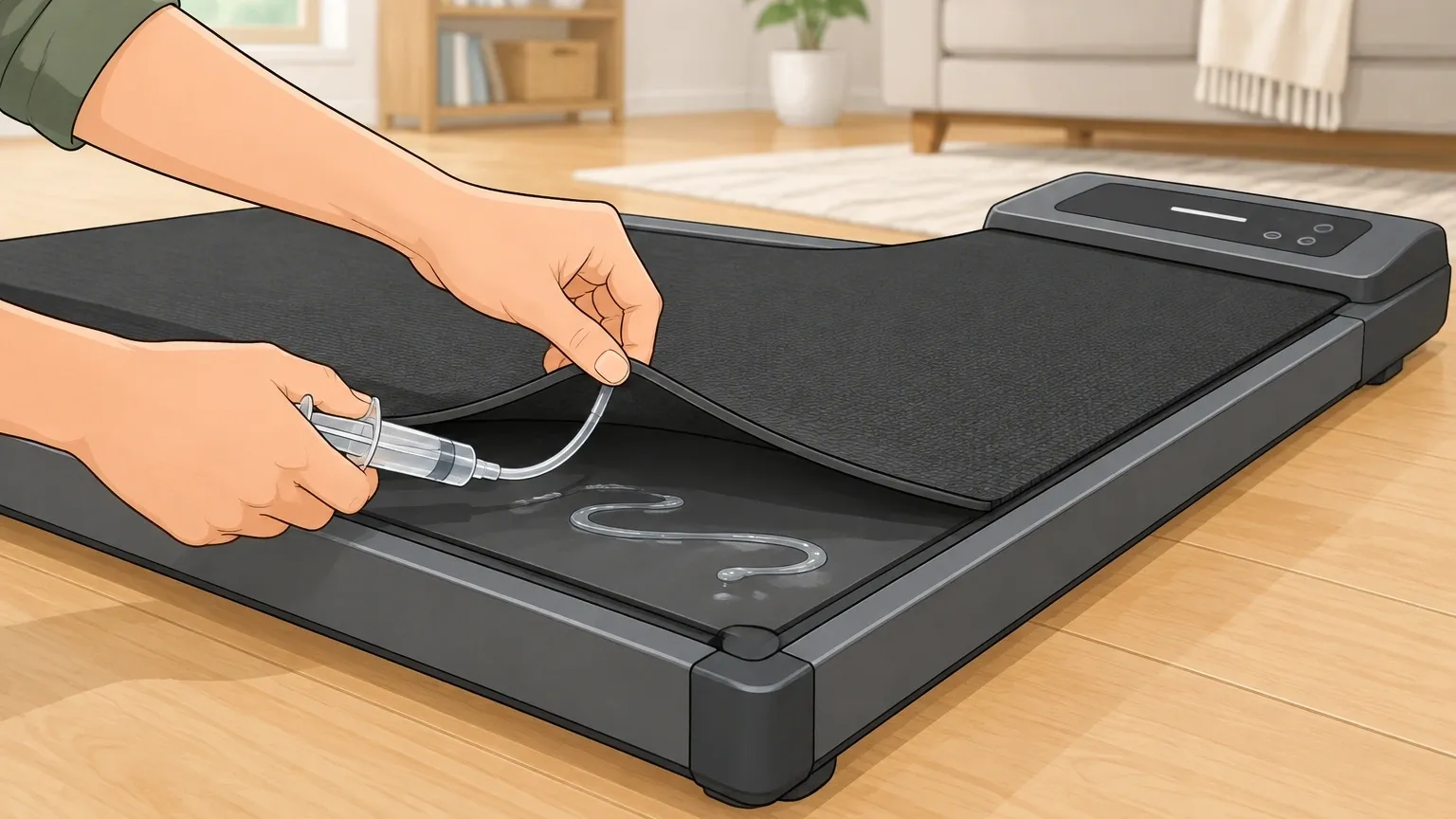
- Apply the oil in an S-pattern from front to back along the deck. Use about 5 to 10 ml total. Do not pour it all in one spot; spread it across the width of the belt path. Repeat on the opposite side for even coverage.
- Plug the machine back in and let it run at 1 to 2 km/h (roughly 0.6 to 1.2 mph) for 3 to 5 minutes with no one standing on it. This distributes the oil across the full deck.
- Step on and walk for another couple of minutes at a comfortable pace to help the oil settle into the contact points.
That is the basic method. Now let us address the most common frustration.
How to Lubricate a Walking Pad with Tight Belt Clearance
Many compact and folding walking pads, like the WalkingPad R2, A1 Pro, or cheaper unbranded models, leave almost no room between the belt and the deck. You cannot fit a standard nozzle under there.
I have measured some decks where the gap is less than 1 cm. Here are three real solutions that work.
Use a Syringe with a Flexible Extension
Buy a plastic syringe (10 ml or larger) and attach a short piece of flexible silicone tubing. Draw the lubricant into the syringe, then gently push the tube under the belt from the side.
Squeeze the oil out while moving the tube from front to back. This lets you reach deep without forcing the belt up.
The Edge Injection Method
If even a thin tube will not fit, apply the oil to the belt edge rather than the deck. Squeeze a few drops onto the outer edge of the belt where it meets the roller. Then run the machine at low speed.
The rotating belt will pull the oil inward and spread it across the deck. This method works best if you apply oil to both edges and let the belt run for a full five minutes.
Loosen the Belt Tension
For some models, you can adjust the rear roller bolts to slacken the belt slightly, giving you more room to lift it. Only do this if you are comfortable with belt tension adjustments.
Mark the current position of the bolts so you can return them exactly. After lubricating, retighten the belt to the original tension.
If you are unsure, stick with the syringe or edge injection methods.
How to Check if the Lubricant Spread Evenly
Running the belt for a few minutes is not always enough. Silicone oil does not spread the same way on every deck.
Temperature, belt tension, and even a slight incline on adjustable models can stop the oil from migrating.
After the distribution run, unplug the machine again and perform the hand test at three points: near the front, in the middle, and near the back of the deck.
The surface should feel uniformly slick with no dry patches. If you feel a rough spot, apply a few extra drops to that area and run the belt again.
If the belt slips or feels greasy in one section and dry in another, the oil has pooled. This often happens when the belt tension is too loose.
Tighten the rear roller bolts by a quarter turn on each side and run the belt again. The extra tension helps squeeze the oil into an even film.
How Often Should You Lubricate?
Base your schedule on actual miles or hours walked, not a fixed month count. Here is a simple table to guide you.
| Usage level | Hours per week | Lubrication interval |
|---|---|---|
| Light | Less than 3 hours | Every 6 to 8 months |
| Moderate | 3 to 5 hours | Every 3 to 5 months |
| Heavy | More than 5 hours | Every 2 to 3 months |
If you walk roughly 50 km (about 30 miles) per month, schedule lubrication every three months. But always trust the touch test over the calendar.
If the deck feels dry before the interval is up, lubricate early.
Common Mistakes to Avoid
- Over-lubricating. Too much oil causes belt slip, dripping, and attracts dust. Stick to 5 to 10 ml per session.
- Using the wrong oil. Only 100% silicone. No sprays with solvents, no all-purpose lubricants, no cooking oils.
- Lubricating without cleaning first. If you are reapplying after months of use, wipe the deck with a lint-free cloth slightly dampened with isopropyl alcohol. Let it dry fully for 10 to 15 minutes before adding fresh oil.
- Ignoring the symptoms. Do not wait for grinding noises or heat. At the first sign of drag, lubricate.
Frequently Asked Questions
Can I lubricate my walking pad without unplugging it?
No. Unplugging is non-negotiable for safety.
The belt can activate unexpectedly when the machine is plugged in, even if the power switch is off, due to static discharge or remote start features on smart models.
How do I clean old lubricant off before reapplying?
Use a lint-free cloth slightly dampened with isopropyl alcohol (70% or higher) to wipe the deck surface. Let it dry completely for 10 to 15 minutes before applying fresh silicone oil.
Never use soap, household cleaners, or water directly on the deck.
My walking pad has a permanently lubricated deck. How do I know?
Check your manual for terms like "maintenance-free," "sealed bearing," or "self-lubricating belt." These models typically have a wax-impregnated deck or a belt with embedded lubricant.
If you are unsure, contact the manufacturer with your model number before applying any oil.
Can I use a spray lubricant instead of a bottle?
Only if the spray is specifically labeled as 100% silicone treadmill lubricant. Most spray lubricants contain propellants or solvents that damage belt materials.
If using a spray, apply it to a cloth first, then transfer to the deck. Never spray directly onto the belt or motor area.
What temperature should the room be when I lubricate?
Silicone oil flows best between 15°C and 25°C (59°F to 77°F). Cold oil becomes thick and does not spread evenly.
If your walking pad is in a cold garage or unheated room, warm the lubricant bottle in your hands for two to three minutes before applying.