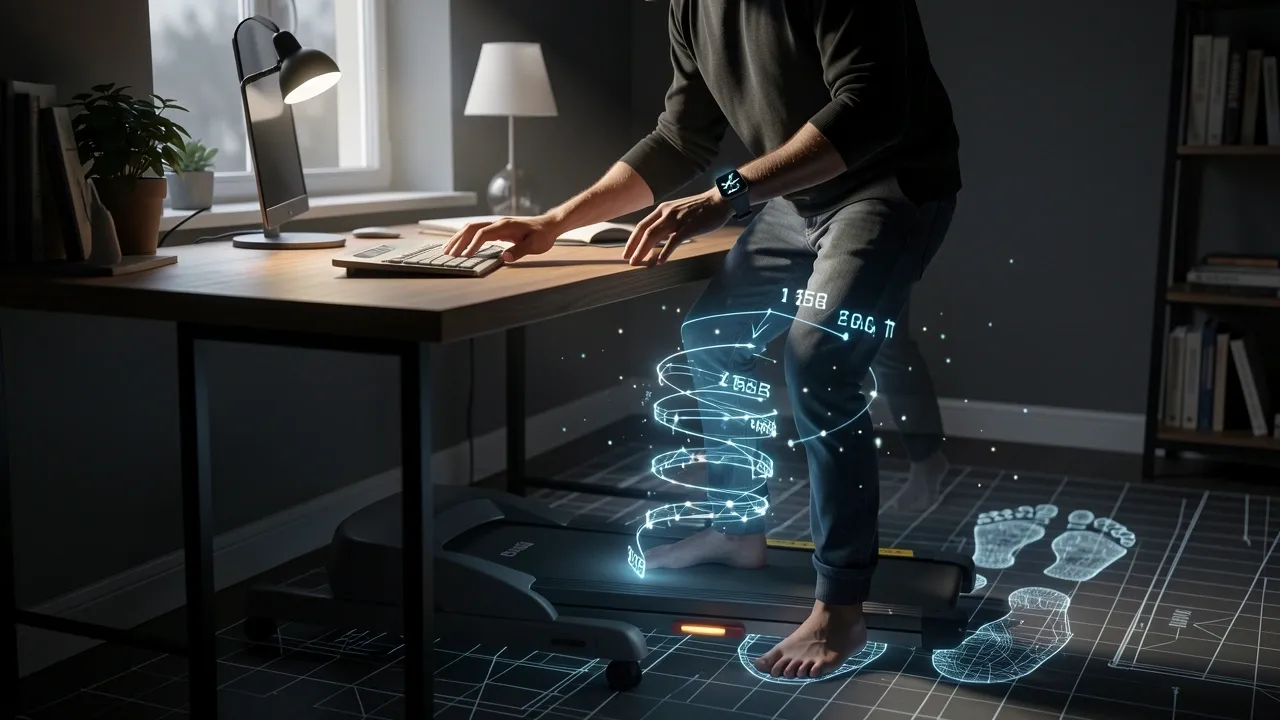
Can Walking Pads Make You Dizzy? Yes, Here Is Exactly Why and How to Stop It

You buy a walking pad to move more while you work or watch TV. Then after a few minutes, your head starts spinning. You feel off balance, maybe a little nauseous. You wonder: is this thing broken?
Or is it just me? It is not just you. Walking pads can make you dizzy, and it happens more often than with regular treadmills. The good news is the cause is usually not a health problem.
It is a problem with how your brain and body interact with the machine. Once you understand that, you can fix it in minutes. I have used a walking pad at my desk for two years.
I also helped a friend troubleshoot the same issue. Here is what I learned about why this happens and what actually works.
Why Walking Pads Cause Dizziness More Than Treadmills
A standard gym treadmill has a long deck, handrails, and usually an incline. You run or walk with a natural stride. Your body gets clear signals about speed and motion. A walking pad is different.
The deck is short. There are no handrails. The belt lies flat on the floor. You start from a seated position. And most people use them while doing something else — typing, reading, looking at a screen.
These differences create a perfect storm for dizziness. Let me break it down by the three main causes I have seen.
The Visual-Vestibular Mismatch

Your sense of balance depends on two systems working together. Your inner ear (vestibular system) feels motion. Your eyes see what is around you. When both agree, you feel stable.
When you walk on a walking pad, your inner ear feels the motion of your legs and body moving forward. But your eyes see a stationary room — walls, desk, chair.
That conflict is called a visual-vestibular mismatch. Your brain gets confused. Dizziness is the result.
Why a Flat Walking Pad Feels Different to Your Brain
When you walk outside, the ground is never perfectly flat. Tiny bumps, slight inclines, and changes in surface texture give your feet and inner ear constant feedback.
Your brain uses that feedback to confirm you are moving. A walking pad belt is perfectly flat and smooth. It provides zero sensory feedback.
Your inner ear says "we are moving," but your feet say "this feels exactly the same as standing still." The mismatch grows. That is why you can feel dizzy even at a very slow speed.
The Dual-Task Dilemma

Most people do not just stand on a walking pad. They walk and type. Walk and read. Walk and watch a video. That is the whole point — you want to be productive while moving.
But dual-tasking puts extra strain on your balance system. Your brain has to process visual information from the screen, coordinate your walking, and maintain stability — all at once.
When the brain gets overloaded, the first thing to go is balance.
Why Looking at a Screen While Walking Creates Conflict
Outdoors, when you walk, your eyes naturally track objects moving past you — trees, buildings, people. That is called optic flow. Your brain uses it to confirm that you are moving forward.
On a walking pad, the screen is static. Or if you are watching a video, the motion on screen does not match your actual movement. Your brain sees one kind of motion and feels another kind.
This sensory confusion is a direct cause of dizziness and nausea. I have experienced it myself when trying to read a PDF while walking.
Blood Flow and the Sitting Start
Walking pads are often used in home offices. You sit in a chair. You stand up. You step onto the pad. You press start.
That sudden transition from zero movement to slow walking — and then back to sitting — can cause a noticeable blood pressure shift. When you sit for a long time, blood pools in your legs.
When you start walking, your heart pumps harder to send blood to your working muscles. If you stop abruptly, blood pressure drops quickly. That drop causes lightheadedness.
This is more common with walking pads because people do not warm up. They go from chair to belt in ten seconds. A proper transition can prevent this.
How to Stop Your Walking Pad From Making You Dizzy
I tried several things over the years. Some worked immediately. Some took a few days to get used to. Here are the fixes that actually work.
Fix 1: Create a Focal Point

Do not look at the floor, the wall directly in front of you, or a moving screen. Look at a fixed point about 10 to 15 feet away.
If you are at a desk, place a small object on your desk at that distance — a cup, a sticky note, a plant. Keep your eyes on it while you walk.
This gives your visual system a stable reference point and reduces the mismatch.
Fix 2: Incline Is Your Friend
Even a small incline changes everything. If your walking pad has an incline setting, use 1% or 2%. That adds a slight tilt that your inner ear can detect. It also mimics outdoor walking more closely.
If your pad does not have incline, you can place a thin board or a folded towel under the front feet. Just make sure it is stable and does not slip.
A rise of one inch at the front can make a big difference.
Fix 3: The Sit-Stand-Walk Protocol
Do not go straight from chair to walking pad. Follow this sequence:
- Stand up and stretch for 30 seconds. Let your blood settle.
- Step onto the pad and start at the slowest speed (0.5 mph).
- Walk for one minute at that speed. Let your body adjust.
- Gradually increase speed by 0.2 mph every 30 seconds until you reach your desired pace.
- When you finish, slow down gradually over one minute, then step off.
- Stand still for 30 seconds before sitting down.
This protocol gives your heart rate and blood pressure time to adjust. It prevents the sudden drop that causes dizziness.
Why Dizziness Happens During Your Walk vs. After You Get Off
The cause is different depending on when it happens.
Dizziness During Your Walk

If you feel dizzy while you are still on the pad, the cause is usually visual-vestibular mismatch or dual-tasking. You are looking at something that does not match your motion.
The fix is to look at a fixed point and reduce screen use. Another common cause: looking down at your feet. The walking pad deck is short, so people often look down to make sure they stay on the belt.
That throws off your neck alignment and confuses your inner ear. Keep your head up and gaze forward.
Dizziness After You Get Off
If you feel dizzy after stepping off, the cause is usually blood pressure drop. Your body needs time to switch from walking mode to standing mode.
That is why the gradual slowdown and standing still after the walk is critical. Some people also feel a "phantom walking" sensation — the ground feels like it is moving under them. That is normal.
It means your vestibular system is still adjusting. It usually goes away within a few minutes.
When Dizziness Is a Sign of Something Else

Most walking pad dizziness is harmless and fixable. But there are symptoms you should not ignore. If you experience any of these, stop using the pad and talk to a doctor:
- Chest pain or tightness
- Sudden severe headache
- Hearing loss or ringing in one ear
- Fainting or nearly fainting
- Dizziness that lasts more than 30 minutes after you stop
- Blurred vision that does not clear
These could be signs of a medical condition unrelated to the walking pad. Do not try to "walk through" dizziness if it feels different from the usual motion-induced type.
Frequently Asked Questions
Can I use a walking pad if I am prone to motion sickness?
Yes, but start slow. Use the lowest speed (0.5 mph) for short sessions of five minutes. Keep a fan blowing on your face — airflow helps reduce nausea. Do not watch a screen. Look at a fixed point.
Gradually increase duration over several days. If you still feel sick, a walking pad might not be for you.
Does the speed of a walking pad affect dizziness more than the duration?
Yes. Rapid acceleration causes the biggest sensory shock. Jumping from 0 to 2 mph instantly confuses your inner ear. Slow, gradual increases in speed are much gentler. Duration matters less.
You can walk for 30 minutes at 1 mph without issue if you start slowly.
Will an anti-fatigue mat under my walking pad help with dizziness?
No, not directly. An anti-fatigue mat reduces joint impact and floor noise. But it does not fix the visual-vestibular mismatch.
In fact, a thick mat can make you feel less stable because the pad sits on a soft surface. Use a thin, firm mat if you want one, but focus on the visual and transition fixes instead.
Is it safe to "walk through" the dizziness?
No. If you feel dizzy while on the walking pad, stop. Step off the belt carefully and sit down. Continuing to walk increases your risk of falling. It also means your body is overloaded. Listen to it.
Once you are stable, try one of the fixes above before starting again.
Final Thoughts
Walking pads are great tools for adding movement to your day. But they have unique quirks that can cause dizziness.
The problem is almost always rooted in how your brain processes motion when you are on a short, flat belt while distracted.
Once you understand that, the fixes are simple: look at a fixed point, add a slight incline, and transition slowly from sitting to walking and back.
I have used my walking pad almost daily for two years. The first week was rough. After I made these changes, the dizziness stopped completely.
Give your body a few days to adapt, and you will likely have the same result.